






|
Getting your Trinity Audio player ready...
|
The Minerals Income Investment Fund (MIIF) recorded more than GH¢5 billion in mineral royalty inflows in 2025, the highest annual inflow in the Fund’s history.
According to MIIF, the figure represents an almost 500 per cent increase since 2020, reflecting the success of strategic reforms, stronger revenue mobilisation and enhanced collaboration with institutions responsible for managing Ghana’s mineral revenues.
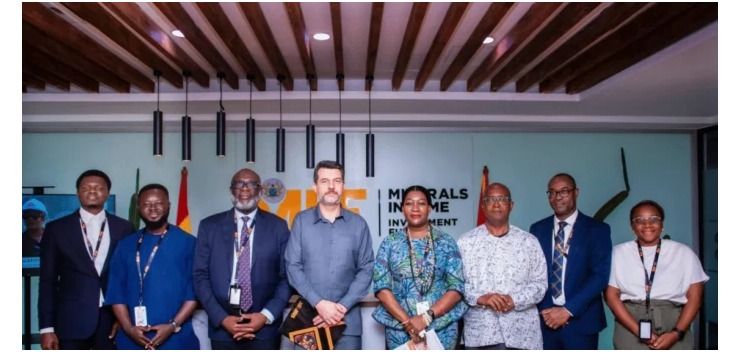
The achievement was highlighted during high-level discussions between MIIF and the International Monetary Fund (IMF) in Accra, where both parties explored measures to strengthen Ghana’s mining sector through improved revenue collection, governance reforms and the formalisation of small-scale mining.
The discussions also reviewed Ghana’s Sliding Scale Royalty Framework, which MIIF described as a balanced mechanism that adjusts royalty payments in response to commodity price movements, protecting government revenues while maintaining investor confidence.
The engagement forms part of Ghana’s broader strategy to maximise returns from its mineral resources by strengthening governance, improving revenue mobilisation and promoting the sustainable management of the country’s natural wealth.
Speaking during the meeting, MIIF Chief Executive Officer Justina Nelson said the Fund’s record performance demonstrates the effectiveness of its revenue mobilisation strategy despite exchange rate fluctuations and challenging market conditions.
She attributed the growth to stronger collaboration with key institutions, including the Ghana Revenue Authority (GRA), the Minerals Commission, the Ghana Gold Board and the Ghana National Association of Small-Scale Miners.
Mrs. Nelson described the small-scale mining sector as a significant opportunity for Ghana’s economic transformation, noting that ongoing formalisation efforts are expected to expand the country’s royalty base while improving compliance across the industry.
Head of Investment at MIIF, Ernest Attiso, said the Fund remains focused on maximising royalty collections in partnership with the GRA while investing the proceeds to generate long-term value for both current and future generations.
He explained that MIIF’s strategic plan through 2028 prioritises enhanced royalty mobilisation, stronger governance, improved compliance and risk management, as well as continued growth in assets under management.
According to Mr. Attiso, the Fund is also pursuing investments in mineral exploration, near-production assets, mineral processing and beneficiation infrastructure, small-scale mining formalisation, and royalty and streaming financing models to deepen value creation across Ghana’s mining value chain.
He added that MIIF remains committed to Environmental, Social and Governance (ESG) principles through initiatives such as afforestation, heritage and tourism development, and women empowerment programmes in mining communities.
The IMF welcomed MIIF’s contribution to strengthening mineral revenue mobilisation as part of Ghana’s broader fiscal reform agenda.
The IMF Resident Representative, Adrian Alter, identified fiscal discipline, debt sustainability and domestic revenue mobilisation as critical pillars for maintaining macroeconomic stability and supporting sustainable private sector-led growth.
Dr. Alter also underscored the importance of greater transparency, stronger reporting standards and improved management of fiscal risks associated with state-owned enterprises.
He observed that although Ghana’s small-scale mining sector contributes significantly to mineral production, much of its output remains outside the formal royalty system because of informality and environmental challenges. He expressed optimism that MIIF’s ongoing formalisation efforts would improve royalty collection while promoting more sustainable mining practices.
Source: 3news


