





|
Getting your Trinity Audio player ready...
|
In recent years, the relationship between the Gulf Cooperation Council (GCC) states
comprising the United Arab Emirates (UAE), Saudi Arabia, Qatar, Kuwait, Bahrain, Oman,
and African nations has evolved into a robust partnership characterized by substantial
investments and strategic collaborations. This burgeoning alliance is often hailed as a “new
heaven”; for both regions, fostering economic growth, infrastructure development, and mutual
prosperity.
A Surge in Foreign Direct Investment (FDI)
Over the past decade, GCC countries have collectively invested over $100 billion in Africa,
marking a significant shift in the continent’s investment landscape. The UAE has emerged as
a leading investor, committing approximately $59.4 billion, while Saudi Arabia and Qatar
have invested $25.6 billion and $7.2 billion, respectively. Notably, in 2022 and 2023 alone,
the UAE announced total deals of $97 billion, underscoring its aggressive investment
strategy in Africa.
Diverse Investment Sectors
The Gulf Cooperation Council (GCC) states have diversified their investments across Africa,
targeting key sectors to foster economic growth and mutual benefits.
Renewable Energy
The United Arab Emirates (UAE) has emerged as a leading investor in Africa’s renewable
energy sector, committing $72 billion between 2019 and 2023. These investments aim to
support the continent’s transition to sustainable energy sources, addressing both energy
deficits and environmental concerns. Projects span various countries, focusing on solar and
wind energy developments, which are pivotal for reducing carbon emissions and promoting
green energy adoption.
Infrastructure and Ports
GCC countries have strategically invested in Africa’s infrastructure, particularly in port
development and transportation. The UAE’s DP World operates seaports in nations such as
Angola, Djibouti, Egypt, Morocco, Mozambique, Senegal, and Somaliland, enhancing trade
logistics and regional connectivity. Additionally, Abu Dhabi Ports, in collaboration with
Hutchison Port Holdings, is exploring projects to elevate the Port of Dar es Salaam in
Tanzania as a world-leading trade hub. These investments are crucial for facilitating trade and
supporting economic integration across the continent.
Agriculture and Food Security
In response to food security concerns, Saudi Arabia has invested heavily in Africa’s
agribusiness, particularly in East Africa, with a portfolio covering approximately two million
hectares. These investments aim to secure a stable food supply for the Gulf states while
contributing to agricultural development in Africa. The focus includes cultivating essential
crops and developing infrastructure to support large-scale farming, benefiting both local
economies and the broader food supply chain.
Telecommunications
The UAE’s Etisalat, now branded as (e&), operates across multiple African countries,
including Egypt, Nigeria, and Ivory Coast, contributing to the continent’s digital
infrastructure. Similarly, Qatar-based Ooredoo operates networks in Algeria and Tunisia.
These telecommunications investments are pivotal in enhancing connectivity, supporting
digital economies, and providing millions with mobile and internet services, bridging the
digital divide and fostering economic development.
Trade Relations and Economic Integration
Trade between the GCC and Africa has seen exponential growth. Over the last decade:
UAE’s Trade with Africa
The UAE has emerged as Africa’s biggest trading partner within the GCC, with total trade
volume exceeding $60 billion annually. Key trade partners include Egypt, Kenya, and South
Africa. The UAE is a major re-export hub, with Dubai serving as a critical gateway for
African goods, particularly in gold, minerals, and agricultural products. Kenyan exports to the
UAE, for instance, reached $430 million in 2023, while Egypt has strengthened its trade ties,
exporting petroleum, textiles, and food products to the UAE, further enhancing economic
relations.
Saudi Arabia’s Trade with Africa
Saudi Arabia’s trade with Africa has grown 12-fold in the past decade, with total trade
volume surpassing $40 billion. Egypt is a primary trading partner, with Saudi investments in
infrastructure and energy projects exceeding $10 billion. In West Africa, Saudi Arabia has
boosted trade with Senegal and Nigeria, particularly in oil exports, construction materials,
and food products. The expansion of trade agreements between Riyadh and African nations
has also facilitated the export of agricultural goods and strengthened bilateral economic
cooperation.
Qatar’s Role in Economic Integration
Qatar has strengthened its trade and economic partnerships with several African nations,
focusing on energy, finance, and infrastructure. With trade investments exceeding $15
billion, Qatar has deepened ties with Sudan, where it has heavily invested in mining and
agriculture. In addition, Qatar’s investment in South Africa’s banking sector, including
strategic partnerships with financial institutions, has facilitated trade financing and economic
expansion. Furthermore, Qatari companies have participated in infrastructure projects in
Ethiopia and Tanzania, contributing to regional development and economic stability.
The African Continental Free Trade Area (AfCFTA) and GCC Opportunities
The implementation of the African Continental Free Trade Area (AfCFTA) in 2021 has
created a single market for 1.7 billion people, projected to reach $6.7 trillion in business
spending by 2030. This has opened vast opportunities for GCC investors to access unified
African markets with reduced trade barriers. The UAE and Saudi Arabia have positioned
themselves as key players in Africa’s logistics and manufacturing sectors, leveraging
AfCFTA’s framework to facilitate smooth trade and investment expansion. This economic
integration is expected to boost intra-regional trade and enhance Africa-GCC partnerships in
the coming years.
Strategic Collaborations and Future Prospects
The Gulf states are not just investing but also fostering strategic collaborations. In October
2024, Saudi Crown Prince Mohammed bin Salman visited Cairo to discuss investment
opportunities with Egyptian President Abdel Fattah al-Sisi, signalling a shift from direct
financial aid to sustainable investments. Moreover, ACWA Power has signed deals worth
over $1.78 billion in North Africa, focusing on renewable energy and battery storage projects.
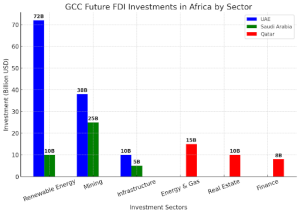

The diagram highlights the future FDI commitments of UAE, Saudi Arabia, and Qatar in
Africa, focusing on renewable energy, mining, infrastructure, energy, real estate, and finance.
The UAE leads in investment, committing $72B to renewable energy and $38B to mining.
Saudi Arabia prioritizes mining ($25B) and industrial projects ($5B), aligning with its Vision
2030. Qatar focuses on energy ($15B), real estate ($10B), and finance ($8B). The GCC’s
investments indicate a strategic shift from oil dependency to Africa’s economic sectors,
strengthening their influence in the continent’s energy, infrastructure, and financial markets
for long-term partnerships.
Why This Relationship is the “New Heaven”
The Gulf-Africa relationship is proving to be a win-win situation for both regions.
Economic Growth and Development
The large-scale investments by the Gulf States are fuelling economic growth across Africa.
Infrastructure projects are improving connectivity, reducing logistics costs, and creating job
opportunities. Industrial parks and special economic zones funded by GCC investors are
boosting manufacturing and export capacities, leading to sustainable development.
Diversification of Gulf Economies
The Gulf States are actively seeking to diversify their economies beyond oil dependence.
Africa’s untapped markets provide an opportunity for the Gulf to expand in sectors like
agribusiness, logistics, and digital services. This diversification helps stabilize the GCC
economies and reduce reliance on traditional revenue sources.
Strengthening Trade and Investment Networks
Enhanced trade agreements between the GCC and African nations create a streamlined
investment climate. The Gulf’s financial institutions and sovereign wealth funds are injecting
capital into African start-ups, fintech ventures, and emerging industries, fostering innovation
and long-term economic resilience.
Geopolitical and Strategic Influence
By establishing deeper economic ties with Africa, the Gulf States are strengthening their
geopolitical influence. This relationship allows the GCC countries to secure essential
resources, ensure food security, and counterbalance the influence of other global players like
China and the European Union in Africa.
Human Capital and Knowledge Transfer
GCC investments in African universities, research centers, and vocational training programs
contribute to human capital development. Initiatives focusing on education, technology
transfer, and skill enhancement are equipping African youth with the expertise needed to
participate in a rapidly evolving global economy.
Conclusion
The evolving ties between the Gulf States and Africa highlight a promising era of
cooperation, investment, and growth. With billions flowing into diverse sectors and economic
integration deepening, this partnership is reshaping Africa’s development trajectory while
securing vital interests for the Gulf states. As trade and investment continue to flourish, the
Gulf-Africa relationship will remain one of the most influential economic alliances of the
21st century.