



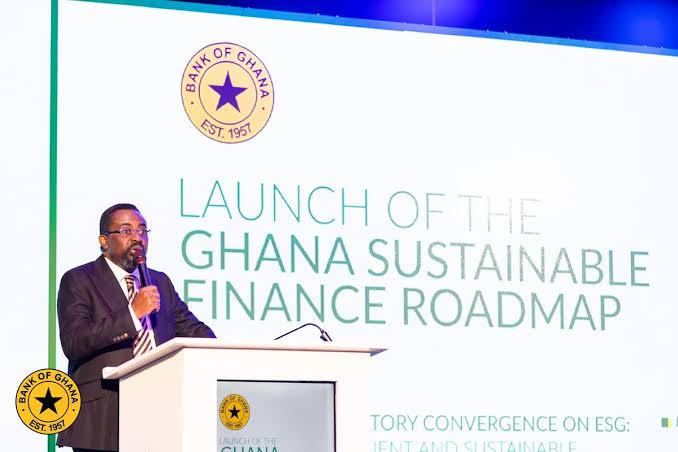
The Governor of the Bank of Ghana, Johnson Pandit Asiama, has launched a national sustainable finance roadmap aimed at positioning Ghana as a leading regional hub for green finance and climate-resilient investment.
Speaking at the launch in Accra on Tuesday, June 30, Dr. Asiama said the roadmap builds on nearly a decade of deliberate efforts to integrate sustainability into Ghana’s financial sector.
He recalled that in 2015, the Bank of Ghana established a multi-stakeholder committee, later formalised as the Sustainable Banking Principles Steering Committee, bringing together the central bank, the Ghana Association of Banks and the Environmental Protection Agency.
That collaboration culminated in the introduction of the Sustainable Banking Principles and Sector Guidance Notes in 2019, providing a framework for managing environmental and social risks, promoting green investment and aligning financial intermediation with Ghana’s national development priorities.
According to Dr. Asiama, all 23 commercial bank chief executives voluntarily endorsed the principles, committing their institutions to embed sustainability into governance structures, risk management frameworks and business operations.
“This unified commitment marked a turning point, signalling the readiness of Ghana’s banking sector to embrace sustainability not as an obligation, but as a strategic imperative,” he said.
He added that with support from the International Finance Corporation and the Swiss Secretariat for Economic Affairs, the Bank developed a standardised compliance framework in 2021. Compliance with the Sustainable Banking Principles has since risen steadily, reaching an industry average of 73 per cent as of September 2025.
Dr. Asiama further highlighted the publication of the Bank’s 2024–2028 Strategic Plan on Sustainability and Climate-Related Risks and the introduction of the Climate-Related Financial Risk Directive, which strengthens the ability of regulated financial institutions to identify, assess and manage climate-related financial risks.
He explained that the newly launched roadmap brings together various sustainability initiatives under a single coordinated framework for Ghana’s financial regulators.
The roadmap is built on three strategic pillars: Environmental, Social and Governance (ESG) Integration, Climate-Related Risk Management, and Financing Sustainability.
According to the Governor, each pillar contains practical actions assigned to relevant regulatory institutions to ensure the roadmap moves beyond policy aspirations to measurable implementation.
“These actions will strengthen our collective ability to anticipate emerging risks, respond proactively, and unlock new opportunities that support inclusive and sustainable economic growth,” he said.
Dr. Asiama noted that the financing sustainability pillar focuses on mobilising private and institutional capital, expanding green and blended finance, and positioning Ghana as a regional destination for sustainable investment.
He stressed that the success of the roadmap would ultimately depend on effective implementation.
“Sustainable finance is not only about managing risks. It is also about positioning Ghana to access new pools of global capital, to finance critical infrastructure, to support the energy transition, to deepen our financial markets, and to strengthen long-term growth,” he said.
He added that the initiative presents an opportunity to build a more resilient banking system while strengthening Ghana’s claim to regional leadership in sustainable finance.
“In this way, we do not merely regulate for stability; we actively shape a financial ecosystem that positions Ghana to fully leverage emerging opportunities within the global sustainable finance landscape,” Dr. Asiama stated.
Source: 3news
