






|
Getting your Trinity Audio player ready...
|
In an era where governments across the world are experimenting with digital transformation, Abu Dhabi has chosen a far more ambitious path. Rather than simply digitizing public services, the emirate is seeking to fundamentally redesign how government functions through artificial intelligence.
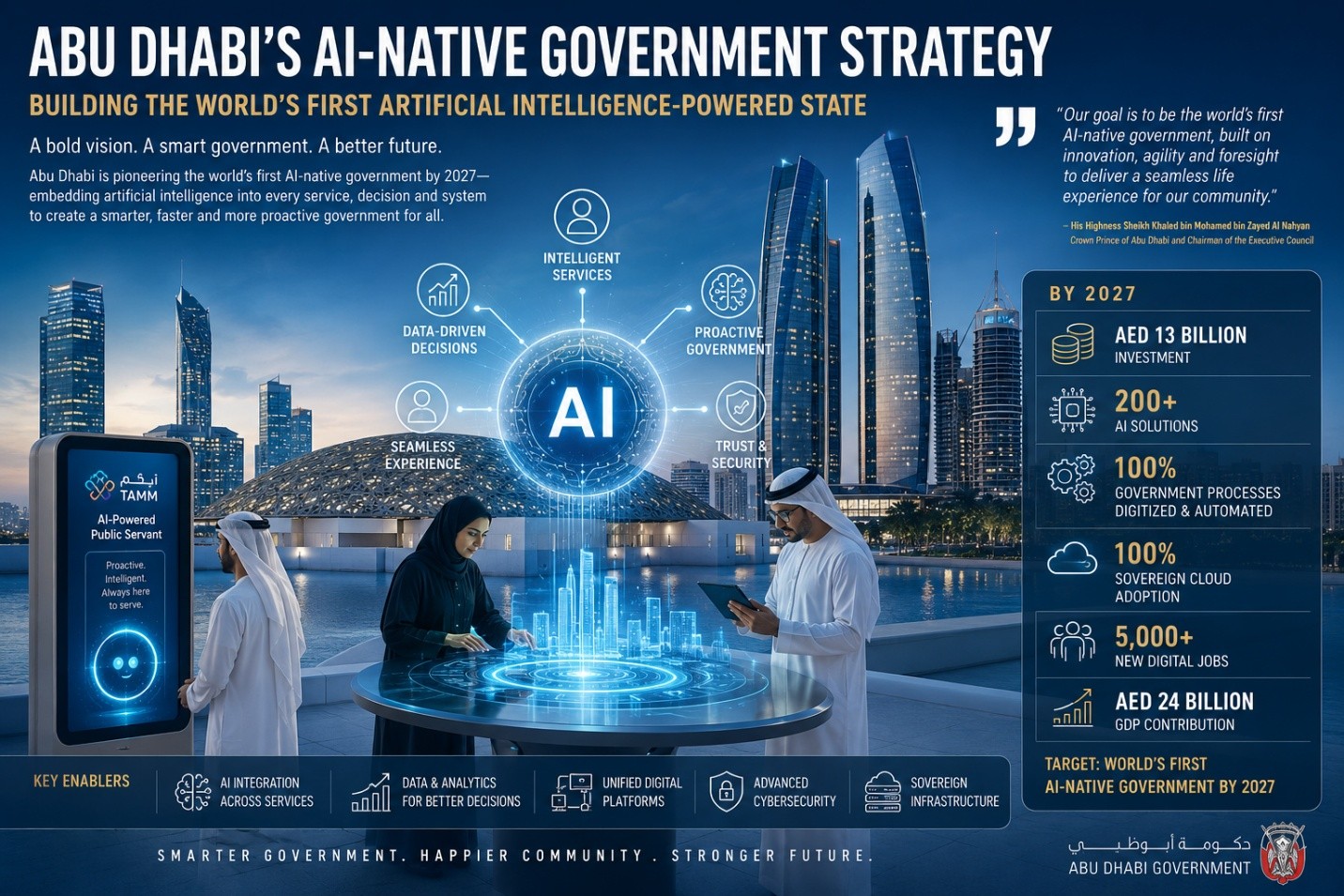
Under the Abu Dhabi Government Digital Strategy 2025-2027, the emirate has committed approximately AED 13billion (US$3.5 billion) toward becoming the world’s first fully AI-native government by 2027. This initiative is not merely a technology upgrade. It represents a transformation in governance, public administration, decision-making, service delivery, and economic management. The strategy seeks to embed artificial intelligence into every layer of government operations, making Abu Dhabi a global laboratory for the future of public sector innovation.
As governments worldwide struggle with bureaucracy, rising public expectations, and increasing fiscal pressures, Abu Dhabi is attempting to answer a fundamental question: Can artificial intelligence create a government that is faster, smarter, more proactive, and more responsive to citizens?
The Vision: From Digital Government to AI-Native Government
For more than two decades, governments have pursued digitalization. Citizens can now renew licenses online, pay taxes electronically, and access services through digital portals.
Abu Dhabi’s vision goes significantly beyond digital government. An AI-native government is one in which artificial intelligence is integrated into the design and execution of public services from the outset. Instead of citizens navigating government systems, government systems anticipate and respond to citizens’ needs automatically.
The objective is not simply automation. It is intelligent governance. According to the Department of Government Enablement (DGE), the strategy aims to transform how government serves people, makes decisions, manages resources, and creates public value. Artificial intelligence will become an operational layer across the entire public sector.
A Historic Investment: AED 13Billion for Government Transformation
At the heart of the initiative is one of the largest public-sector AI investments globally.
Key Investment Figures
| Indicator | Target |
| Total Investment | AED 13Billion |
| Implementation Period | 2025–2027 |
| AI Solutions Planned | More than 200 |
| Government Processes | 100% Digitized and Automated |
| Sovereign Cloud Adoption | 100% |
| New Digital Jobs | Over 5,000 |
| Expected GDP Contribution | AED 24Billion by 2027 |
These figures demonstrate that Abu Dhabi views artificial intelligence not merely as a governance tool but as a strategic economic asset capable of generating productivity gains, attracting investment, and stimulating innovation-led growth.
Five Strategic Pillars of the AI-Native Government
Full AI Integration Across Government Services
The Abu Dhabi Government aims to embed artificial intelligence into virtually every public service, transforming how citizens, residents, and businesses interact with government institutions. Rather than relying on traditional application-based processes, AI systems will proactively identify needs and initiate services automatically. For example, permits, licenses, social support services, and healthcare interventions could be triggered through predictive analytics. This approach reduces bureaucracy, shortens processing times, minimizes human error, and creates a more responsive public sector capable of delivering seamless, citizen-centric services around the clock.
Data-Driven Decision Making
A central pillar of Abu Dhabi’s AI-native government strategy is the use of real-time data and advanced analytics to support policymaking and public administration. Artificial intelligence systems will continuously process large volumes of information from multiple sectors, providing government leaders with timely insights and predictive forecasts. This enables policymakers to anticipate challenges before they emerge, allocate resources more efficiently, and make evidence-based decisions. By replacing reactive governance with predictive governance, Abu Dhabi seeks to improve economic planning, infrastructure development, public service delivery, and crisis management.
Sovereign Cloud Infrastructure
The success of an AI-powered government depends on secure, scalable, and reliable digital infrastructure. Abu Dhabi’s sovereign cloud initiative ensures that government data remains protected under national jurisdiction while meeting stringent privacy, security, and regulatory requirements. This infrastructure provides the computational capacity needed for advanced AI applications and supports seamless data sharing across government entities. By maintaining control over critical data assets and reducing dependence on external platforms, Abu Dhabi strengthens digital sovereignty, enhances cybersecurity resilience, and builds public trust in government digital services.
Unified Government Platforms
Historically, government agencies have operated independently, often resulting in fragmented systems and duplicated processes. Abu Dhabi’s strategy seeks to integrate all government entities into a unified digital ecosystem where information can flow securely and efficiently across departments. This interconnected approach enables agencies to collaborate more effectively, eliminates administrative redundancies, and provides citizens with a single, streamlined experience when accessing public services. The integration of data, platforms, and processes will allow government institutions to function as one coordinated system rather than separate bureaucratic structures.
Advanced Cybersecurity and Trust
As artificial intelligence becomes increasingly embedded in government operations, safeguarding data and maintaining public confidence become critical priorities. Abu Dhabi’s strategy places cybersecurity and responsible AI governance at the core of its transformation agenda. Advanced security frameworks will protect sensitive information from cyber threats while ensuring compliance with privacy regulations. Simultaneously, ethical AI principles will guide the development and deployment of intelligent systems to promote transparency, accountability, fairness, and human oversight. Building trust is essential to ensuring long-term public acceptance and successful adoption of AI-driven governance.
TAMM AutoGov: The World’s First AI Public Servant?
Unveiled at GITEX Global 2025, TAMM AutoGov is an AI-powered government service platform designed to transform public service delivery in Abu Dhabi. Unlike traditional digital services that require citizens to initiate requests, TAMM AutoGov proactively anticipates needs and delivers services automatically. Its functions include automatic license renewals, timely notifications, payment reminders, and streamlined administrative processes. The initiative represents a shift from reactive governance to proactive governance, enhancing efficiency, reducing bureaucracy, and improving the overall citizen experience through artificial intelligence.
Building the Infrastructure: The Role of AI Supercomputing
A sophisticated AI-native government requires enormous computing power. To support its ambitions, Abu Dhabi is simultaneously investing in next-generation AI infrastructure. Among the most significant developments is Stargate UAE, a massive AI data center project being developed through collaboration between G42, Open AI, Oracle, Nvidia, Cisco, and SoftBank. The facility is expected to become one of the largest AI computing hubs outside the United States and will provide the computational backbone necessary for large-scale AI deployment across government and industry.
Economic Impact: AI as a Growth Engine
The strategy is not solely about governance. Abu Dhabi views artificial intelligence as a major driver of economic diversification. Expected benefits include:
Enhanced Productivity
Artificial intelligence is expected to significantly improve productivity across Abu Dhabi’s public and private sectors by automating repetitive administrative tasks, accelerating decision-making processes, and reducing operational inefficiencies. Government agencies will be able to process applications faster, allocate resources more effectively, and deliver services with greater accuracy. These efficiency gains can lower operational costs while improving citizen satisfaction and overall economic performance.
New Employment Opportunities
Contrary to concerns that AI will eliminate jobs, Abu Dhabi’s strategy is expected to create thousands of new employment opportunities in emerging technology sectors. Demand will increase for professionals in artificial intelligence, data science, cloud computing, cybersecurity, software engineering, and digital governance. The initiative will also stimulate investment in education and workforce development, preparing citizens for high-value careers in the digital economy.
Increased GDP Contribution
The Abu Dhabi Government projects that its digital transformation and AI initiatives could contribute approximately AED 24 billion to the emirate’s economy by 2027. This growth is expected to result from increased productivity, enhanced government efficiency, greater private-sector innovation, and the attraction of foreign direct investment. By positioning itself as a global AI hub, Abu Dhabi aims to diversify its economy beyond hydrocarbons and strengthen long-term economic resilience.
Global Implications
Abu Dhabi’s experiment is being closely watched by policymakers worldwide. The he emirate could establish a new benchmark for government modernization, much as Estonia became synonymous with e-government in the early digital era.
The initiative also reinforces the UAE’s broader ambition to become a global leader in artificial intelligence, complementing national efforts such as the UAE AI Strategy 2031, the establishment of the Artificial Intelligence and Data Authority, and the country’s growing investments in AI infrastructure and research.
For developing economies, particularly in Africa, the Abu Dhabi model offers important lessons on how strategic leadership, infrastructure investment, and institutional coordination can accelerate digital transformation.
Implications for Africa-Abu Dhabi Relations
Deepening Digital and AI Partnerships
Abu Dhabi’s AI-Native Government Strategy positions the UAE as a leading exporter of digital governance expertise to Africa. As African governments pursue e-government reforms, digital identity systems, smart cities, and public sector modernization, Abu Dhabi can become a key strategic partner through investment, technology transfer, capacity building, and AI infrastructure development. This could accelerate Africa’s digital transformation while strengthening UAE influence across emerging African markets.
Expanding Investment and Economic Connectivity
The strategy is likely to attract increased UAE investment into Africa’s digital economy, including data centers, cloud infrastructure, fintech, cybersecurity, and artificial intelligence startups. Abu Dhabi’s growing technological capabilities complement Africa’s rapidly expanding digital market, creating opportunities for joint ventures, innovation hubs, and knowledge-sharing platforms that support long-term economic diversification and sustainable development across the continent.
Implications for Ghana
Modernization of Public Administration
For Ghana, Abu Dhabi’s experience provides a practical model for modernizing public administration through AI-driven service delivery, digital revenue mobilization, smart urban management, and data-informed policymaking. Institutions such as the Ghana Revenue Authority, National Identification Authority, and Metropolitan, Municipal and District Assemblies could leverage similar technologies to improve efficiency, transparency, and citizen engagement while reducing administrative bottlenecks.
New Opportunities for Investment and Skills Development
Ghana stands to benefit from increased UAE investment in technology infrastructure, digital innovation, and human capital development. Partnerships with Abu Dhabi-based technology firms and institutions could support AI training, research collaboration, startup financing, and digital entrepreneurship. Such cooperation would enhance Ghana’s competitiveness in the Fourth Industrial Revolution while positioning the country as a regional hub for digital innovation in West Africa.
Conclusion
Abu Dhabi’s AI-Native Government Strategy is among the most ambitious public-sector transformation initiatives ever undertaken. Backed by AED 13billion in investment, a commitment to full AI integration, sovereign cloud infrastructure, advanced cybersecurity, and data-driven governance, the emirate seeks to become the world’s first fully AI-native government by 2027.
Whether the initiative ultimately succeeds or not, it has already redefined the global conversation about the future of governance. The question is no longer whether governments will use artificial intelligence. The question is how profoundly artificial intelligence will reshape the way governments serve their citizens. Abu Dhabi has chosen to lead that experiment.