







|
Getting your Trinity Audio player ready...
|
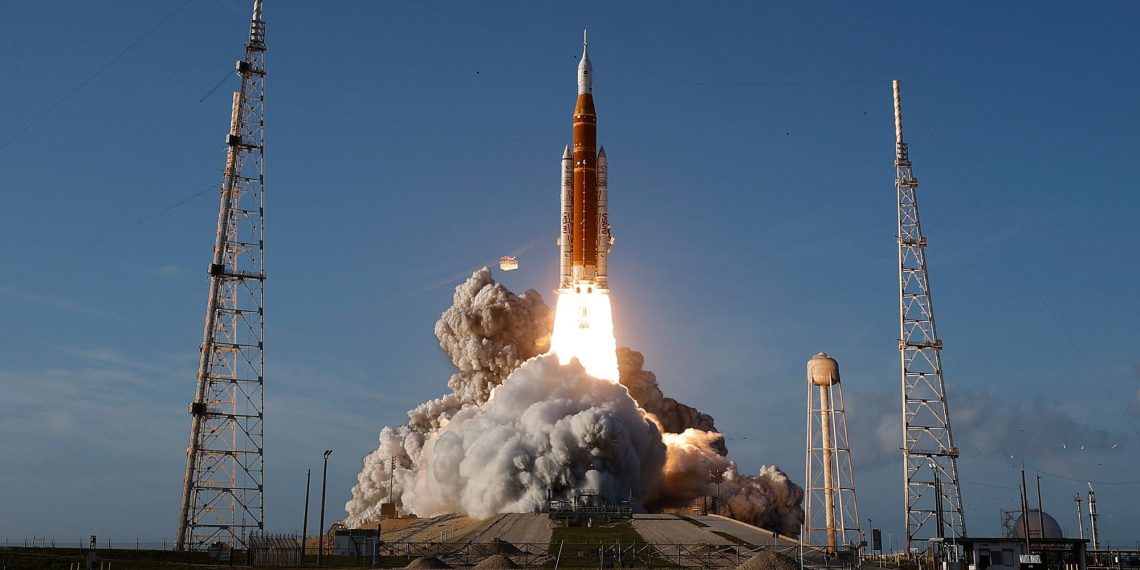
The Artemis II has successfully launched from Florida, carrying four astronauts on a landmark journey around the moon. The mission marks the first time humans have travelled beyond low-Earth orbit in more than 50 years.
Led by NASA, the mission represents a significant step toward returning humans to the moon and eventually sending astronauts to Mars. The crew, including astronaut Christina Koch and Jeremy Hansen of the Canadian Space Agency, is expected to spend nearly 10 days travelling around the moon and back, reaching distances not achieved in decades.
Moments after liftoff, commander Reid Wiseman reported sighting the moon, describing it as a “beautiful moonrise” as the spacecraft headed toward its destination. Launch director Charlie Blackwell-Thompson hailed the mission as a symbol of global collaboration and inspiration for a new generation.
The launch followed hours of heightened tension, particularly during the fueling process, which had previously caused delays due to hydrogen leaks. This time, engineers successfully loaded over 700,000 gallons of fuel into the rocket without incident. Other technical challenges, including issues with the rocket’s flight-termination system and a battery concern in the Orion capsule, were resolved ahead of liftoff.
In the coming days, the crew will conduct system checks in high Earth orbit before performing a translunar injection burn to head toward the moon. The spacecraft will then travel on a free-return trajectory, looping behind the moon and using gravitational forces to return to Earth.
The mission will conclude with a high-speed re-entry into Earth’s atmosphere and a splashdown in the Pacific Ocean, where recovery teams will retrieve the crew.
With many people today having no memory of the Apollo moon missions, Artemis II is being positioned as a defining lunar mission for a new generation.
Source: citinews


