



|
Getting your Trinity Audio player ready...
|
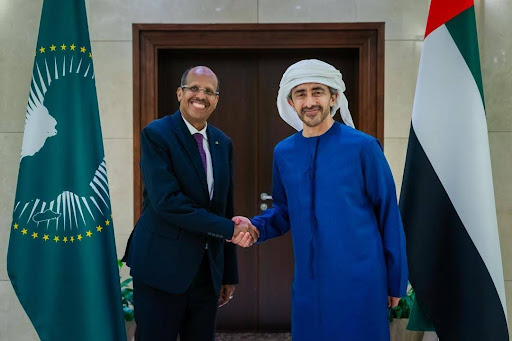
On 11-12 September 2025, AU Commission Chairperson H.E. Mahmoud Ali Youssouf was
warmly received at the UAE Ministry of Foreign Affairs in Abu Dhabi by H.E. Sheikh
Shakhboot bin Nahyan Al Nahyan, UAE Minister of State for Foreign Affairs.
Their high-level consultations reaffirmed the spirit of the AU-UAE partnership and built directly on an existing Memorandum of Understanding to deepen cooperation across economic development, trade,
education, health, peace & security, renewable energy, and digitalization. The two leaders agreed
to create a working group to maintain regular dialogue and drive implementation of priority areas, and the UAE reiterated strong support for AU peace and mediation efforts in Somalia, Sudan and the Democratic Republic of Congo (DRC).
This development is more than ceremonial. It marks a practical intensification of ties between
the African Union and a Gulf partner that is rapidly expanding its political, economic and
diplomatic footprint across the continent. Below is a synthesis of what happened, why it matters,
and what to watch next.
What was agreed – the concrete points
Reaffirmation of the AU–UAE MoU and operational follow-through
The Abu Dhabi consultations placed strong emphasis on reaffirming the Memorandum of
Understanding (MoU) signed earlier in 2025 between the African Union and the UAE. While
MoUs often remain symbolic, this meeting sought to turn commitments into measurable actions.
By establishing a formal working group, both parties agreed to create an institutional mechanism
for accountability, ensuring that promises on cooperation do not fade after the photo opportunity.
The working group will serve as a platform for structured dialogue, joint planning, and progress
tracking, helping transform the AU-UAE partnership from adhoc diplomacy into a systematic,
long-term framework for collaboration.
Priority sectors for cooperation
The leaders identified specific priority sectors that align with Africa’s Agenda 2063 and the
UAE’s own development trajectory. These include economic development and trade, education,
health, peace and security, renewable energy, and digitalization. The emphasis reflects a holistic
approach: from building resilient economies and human capital to strengthening health systems and addressing instability in fragile states. For the UAE, investing in renewable energy and
digitalization in Africa complements its global sustainability and smart technology ambitions.
For Africa, the partnership promises access to finance, technology, and expertise. By clearly
outlining these focus areas, the AU-UAE relationship gains both direction and accountability.
UAE backing for AU mediation and stabilization initiatives
A central outcome of the consultations was the UAE’s firm pledge to support AU-led mediation
and stabilization in Somalia, Sudan, and the DRC; three of Africa’s most volatile conflict theatres. This backing reflects a strategic Gulf approach of blending development finance with diplomacy to create stability. For the AU, it provides valuable political and financial reinforcement of ongoing peace operations, which often face funding gaps and external pressures. For the UAE, playing a role in African conflict resolution elevates its global diplomatic profile. The pledge signals recognition that sustainable development requires peace, and that stability is essential for investment to thrive.
Why this meeting matters
Institutionalizing Cooperation
One of the strongest signals from this meeting is the establishment of a formal AU-UAE working
group. Too often, MoUs remain symbolic, with limited follow-up. By creating a structured
mechanism, both sides are committing to regular dialogue, progress tracking, and accountability.
This institutional approach ensures that promises of cooperation in trade, health, and energy are
translated into tangible projects. It also provides a permanent channel for problem-solving and
adaptation, reducing the risk of delays or miscommunication. For Africa, this means more
predictable partnerships; for the UAE, it means deeper integration into Africa’s continental
development agenda.
Linking Development to Diplomacy
The UAE’s pledge to support AU mediation efforts highlights a deliberate strategy of blending
economic cooperation with political diplomacy. Unlike traditional donors who often separate
development finance from peace efforts, the UAE views them as interconnected: political
stability enables investment, and investments help stabilize fragile states. By tying its support for
peace in Somalia, Sudan, and the DRC to broader development cooperation, the UAE is positioning itself as both an economic partner and a diplomatic ally. This dual role gives the AU added leverage in conflict resolution while reinforcing the UAE’s credibility as a strategic Gulf partner in Africa.
Leveraging Complementary Strengths
Africa and the UAE bring distinct, yet highly complementary, strengths to the partnership. The
UAE contributes financial capital, advanced logistics infrastructure, digital expertise, and
renewable energy know-how, while the AU provides continental legitimacy, political frameworks, and access to 55 member states under Agenda 2063. Together, this synergy can unlock opportunities in areas like cross-border trade integration, energy connectivity, and digital infrastructure expansion. For example, UAE investments in ports, aviation, and renewable energy could directly support AfCFTA’s ambition for seamless intra-African trade. By pooling these assets, the AU and UAE can accelerate progress on shared priorities and build long-term resilience.
Context: UAE’s Recent Africa Engagement
The Abu Dhabi meeting sits within a larger 2025 pattern of intensifying Gulf-Africa ties:
bilateral MoUs, strategic investments, and UAE participation in African multilateral fora. In July
2025 Sheikh Shakhboot and AU Chairperson Mahmoud Ali Youssouf signed a strategic health
partnership MoU on the margins of AU meetings, and the UAE has been visible in humanitarian
and political initiatives, including coordination on Sudan. These threads underscore that the
September consultations are part of an ongoing relationship rather than a single event.
Potential benefits for Africa
Faster project finance and infrastructure delivery
One of the greatest challenges facing African economies is the persistent infrastructure deficit.
The UAE, with its sovereign wealth funds, development banks, and private capital networks, can
provide the large-scale financing needed to accelerate road, rail, port, and airport projects across
the continent. Unlike traditional lenders, Gulf capital often arrives with fewer bureaucratic
delays, enabling quicker project rollouts. When paired with African Union frameworks like the
Programme for Infrastructure Development in Africa (PIDA), UAE-backed financing could fast-
track regional corridors, energy grids, and cross-border connectivity. This acceleration would
reduce trade bottlenecks, enhance competitiveness, and create significant employment
opportunities for Africans.
Technology and digitalization transfers
Africa’s digital economy is projected to reach $712 billion by 2050, but its full potential depends
on external partnerships that provide infrastructure, expertise, and financing. The UAE is a
global hub for smart city technology, fintech, artificial intelligence, and e-government systems,
making it a valuable partner for African states. Collaborations could include expanding
broadband networks, introducing secure e-payment systems, and building digital identity
frameworks that improve service delivery. Through joint ventures, training programs, and
incubation of startups, UAE firms can help accelerate Africa’s digital transformation, ensuring
more inclusive growth and positioning African economies to better compete in the knowledge
economy.
Renewable energy acceleration
Energy access remains a major obstacle in Africa, with more than 600 million people lacking
electricity. The UAE’s world-class expertise in renewable energy showcased by Masdar and its
leadership in COP28 positions it to play a transformative role in Africa’s energy transition.
Large-scale investments in solar farms, wind power, and hybrid mini-grids could significantly
reduce energy poverty while aligning with both the AU’s Agenda 2063 and the Paris Climate
Agreement. Crucially, UAE partnerships can also provide concessional financing, advanced
technology, and training, enabling African states to leapfrog to clean energy systems that are
more sustainable and climate resilient.
Support for AU peace operations and mediation
Peace and stability remain preconditions for Africa’s economic growth. By pledging support for
AU mediation in Somalia, Sudan, and the DRC, the UAE signals a willingness to blend
diplomacy with development. Financial contributions to AU peace operations can strengthen
logistics, equipment, and rapid deployment capacities. Furthermore, UAE diplomatic backing
can amplify AU mediation efforts, lending international legitimacy and mobilizing additional
partners. Importantly, stability in conflict-prone regions creates the enabling environment for
long-term investments in infrastructure, trade, and social development. In this way, the UAE’s
involvement could help the AU close the gap between peacebuilding and economic
transformation.
Practical next steps (what parties should do next)
Operationalize the working group quickly
The AU and UAE must ensure the working group moves from paper to practice within weeks,
not months. This requires defining terms of reference, identifying representatives, and agreeing
on timelines for sectoral meetings. Publishing deliverables and progress updates will enhance
transparency, foster accountability, and build trust across stakeholders.
Negotiate clear financing modalities
Both sides should clarify the nature of financial commitments whether grants, concessional
loans, or blended financing with private sector involvement. Clearer financing structures reduce
ambiguity, ensure projects align with AU Agenda 2063 priorities, and that of UAE’s goals for
member states. Balanced terms foster long-term sustainability and mutual confidence.
Embed monitoring & safeguard clauses
To avoid risks of corruption, environmental damage, or mismanagement, projects must include
robust monitoring frameworks and safeguard clauses. Independent oversight bodies, civil society
participation, and transparent procurement processes will strengthen accountability. Integrating
ESG standards ensures that development projects deliver sustainable benefits.
Prioritize capacity building and local content
The UAE-AU partnership should prioritize skills transfer, training programs, and policies
mandating local participation. Embedding local content in contracts will create jobs, empower
African firms, and strengthen institutional capacity. Beyond infrastructure, investing in human
capital ensures that Africa can independently sustain projects and maximize the benefits of
cooperation by learning from UAE.
Coordinate peace support
UAE contributions to peace efforts in Somalia, Sudan, and the DRC should complement AU
frameworks and regional mechanisms. Joint planning avoids duplication and strengthens African
ownership. Supporting mediation, early recovery, and stabilization while aligning with AU
political processes enhances effectiveness, credibility, and lasting impact in fragile contexts.
Conclusion
The Abu Dhabi consultations between AU Chairperson Mahmoud Ali Youssouf and Sheikh
Shakhboot bin Nahyan Al Nahyan represent a practical deepening of AU-UAE ties. By
institutionalizing dialogue via a working group and linking development cooperation to stabilization and mediation efforts, the AU and UAE have created a platform that could quickly shift from statements to sustained, continent-wide programs. The outcomes will depend on the speed and transparency with which the working group operationalizes commitments, structures financing, and enforces governance safeguards but the potential for positive impact across health, energy, trade and peacebuilding is significant.