







|
Getting your Trinity Audio player ready...
|
Africa must intensify efforts to diversify its crops and adopt sustainable agricultural production systems if it is to meet a projected 50 per cent increase in food demand by 2050, the Food and Agriculture Organization (FAO) has warned.
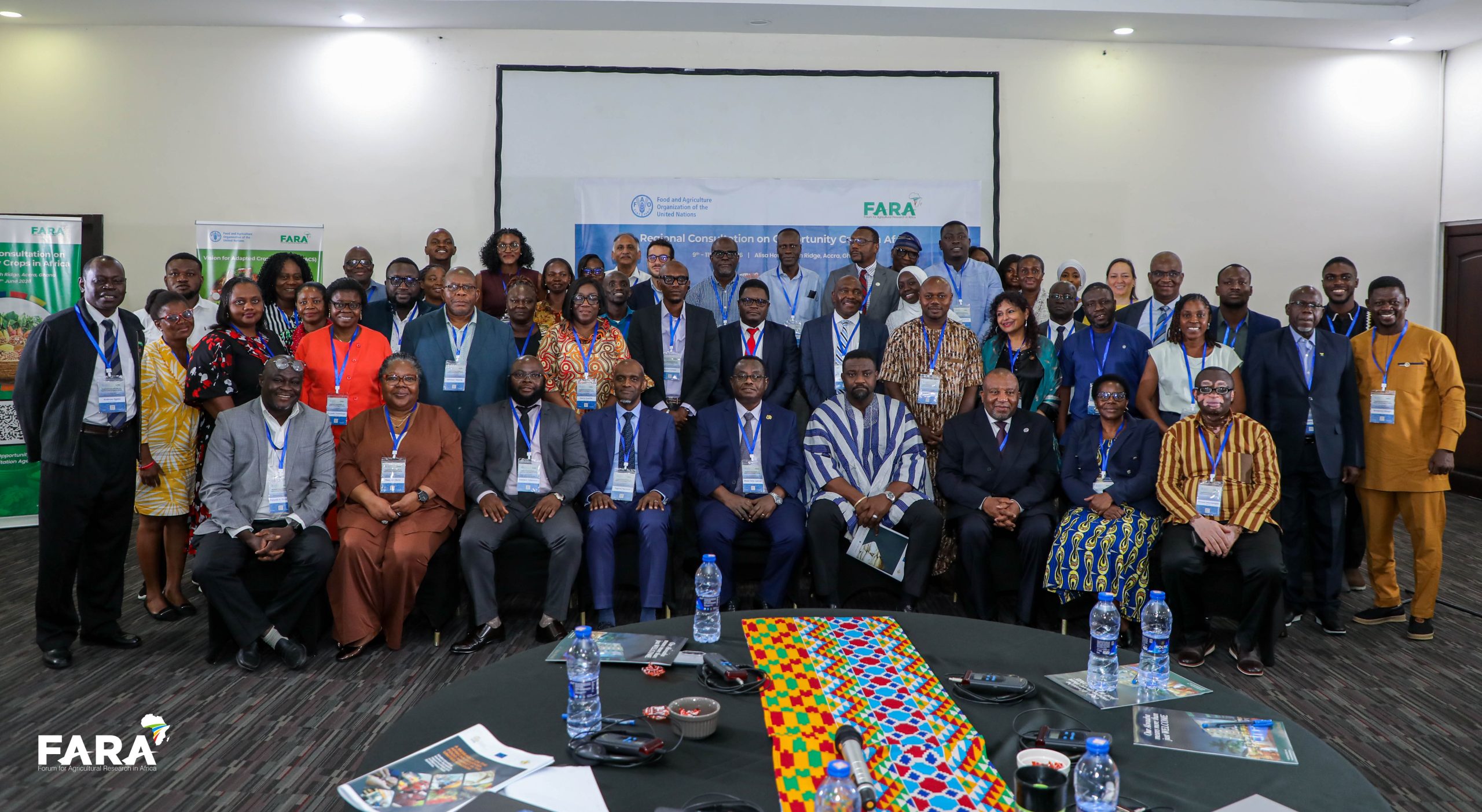
Speaking at the opening of a three-day “Regional Consultation on Opportunity Crops in Africa” in Accra, Dr Chikelu Mba, Deputy Director of the Plant Production and Protection Division at the FAO, stated that global food production must increase significantly to ensure food security for a growing population.
According to him, FAO estimates indicate that the world will need to produce 50 per cent more food than 2012 levels, equivalent to about 9 billion tonnes, to feed the global population adequately by mid-century.
“Every year, FAO, IFAD, the World Food Programme, and UNICEF come together to take stock of the state of food security and nutrition in the world. Isn’t it sobering that in Africa, food insecurity and malnutrition continue to go up?” Dr Mba assessed.
He stressed that achieving food security and improved nutrition on the continent requires the transformation of Africa’s cropping systems to make them more sustainable, resilient, and inclusive.
“At least 80 per cent of all food consumed globally is plant-based, making crop production central to food security,” he said.
Dr Mba explained that the FAO’s strategy is built on three key pillars: seed systems, agronomy, and plant health, supported by innovations, biotechnology, and sustainable agricultural mechanisation.
Focus on Opportunity Crops
The regional consultation, organised by the FAO in partnership with the Forum for Agricultural Research in Africa (FARA), brought together policymakers, researchers, development partners, private-sector actors, civil society organisations, farmer groups and regional institutions.
The meeting aims to accelerate the integration of neglected and underutilised crop species into Africa’s food systems.
These crops, increasingly referred to as “opportunity crops”, include millet varieties, sorghum landraces, fonio, bambara groundnut, indigenous vegetables, and other traditional crops deeply rooted in African food cultures.
Despite their nutritional value and climate resilience, they remain under-researched, underfunded, and poorly represented in formal seed, research, and market systems.
Scientific Investment Required
The Executive Director for the Forum for Agricultural Research in Africa (FARA), Dr Aggrey Agumya, advocated for stakeholders to embrace science as a pivotal point in leading the transformation of the sector, thereby moving away from “promise to prosperity through sentiment alone.”
“Opportunity Crops require robust scientific investments in germplasm conservation, breeding, seed systems, agronomy, mechanisation, value addition, nutrition science, market intelligence, and digital advisory systems. We must generate evidence that demonstrates not only their climate resilience and nutritional superiority but also their economic viability. Science provides the bridge that transforms these crops from being locally admired to becoming globally competitive, from subsistence commodities to profitable enterprises.”
Addressing Key Challenges
Dr. Mba cited findings from FAO’s Third Report on the State of the World’s Plant Genetic Resources, which revealed that only 13 underutilised crop species have been prioritised for commercialisation across sub-Saharan Africa.
He identified several barriers hindering the development of these crops, including the absence of national strategies, poor documentation, inadequate investment in human and institutional capacity, limited postgraduate training opportunities, and persistent skills gaps.
“Our native foods matter because of their high nutritional value, climate resilience, and potential to drive economic empowerment,” he said.
He called for stronger policy support, increased investment in research and development, value addition, market development and strategic partnerships to unlock the full potential of opportunity crops across the continent.
Ghana Leveraging Indigenous Crops
Ghana’s Deputy Minister for Food and Agriculture, John Setor Dumelo, said Ghana is leveraging indigenous and underutilised crops to transform agri-food systems, improve nutrition and build resilience to climate change.
He noted that although African communities have cultivated nutritious and climate-resilient crops for generations, many of these crops have received limited attention in research, policy, investment and commercial agriculture.
According to Mr Dumelo, “opportunity crops” offer significant benefits, including healthier diets, improved climate resilience, biodiversity conservation, increased farmer incomes and more inclusive rural development.
“For Ghana, this agenda is particularly important. The transformation of our agri-food systems requires that we harness the full potential of our agricultural biodiversity whilst creating opportunities for farmers, processors, traders, and agribusinesses,” he stated.
He highlighted Ghana’s contributions to the continental agenda through the Council for Scientific and Industrial Research (CSIR), particularly the Savannah Agricultural Research Institute (SARI).
He further disclosed that the Ministry of Food and Agriculture, in collaboration with the FAO, has implemented the “Support to Women Fonio Value Chain Actors in Ghana” project. This initiative seeks to elevate fonio “from a neglected and underutilised species to a more competitive and commercially viable value chain capable of standing alongside established staples such as rice and maize.”
The consultation is expected to generate recommendations for strengthening policy, research, and investment frameworks to promote opportunity crops as a pathway to food security, climate resilience, and sustainable agricultural development across Africa.


