



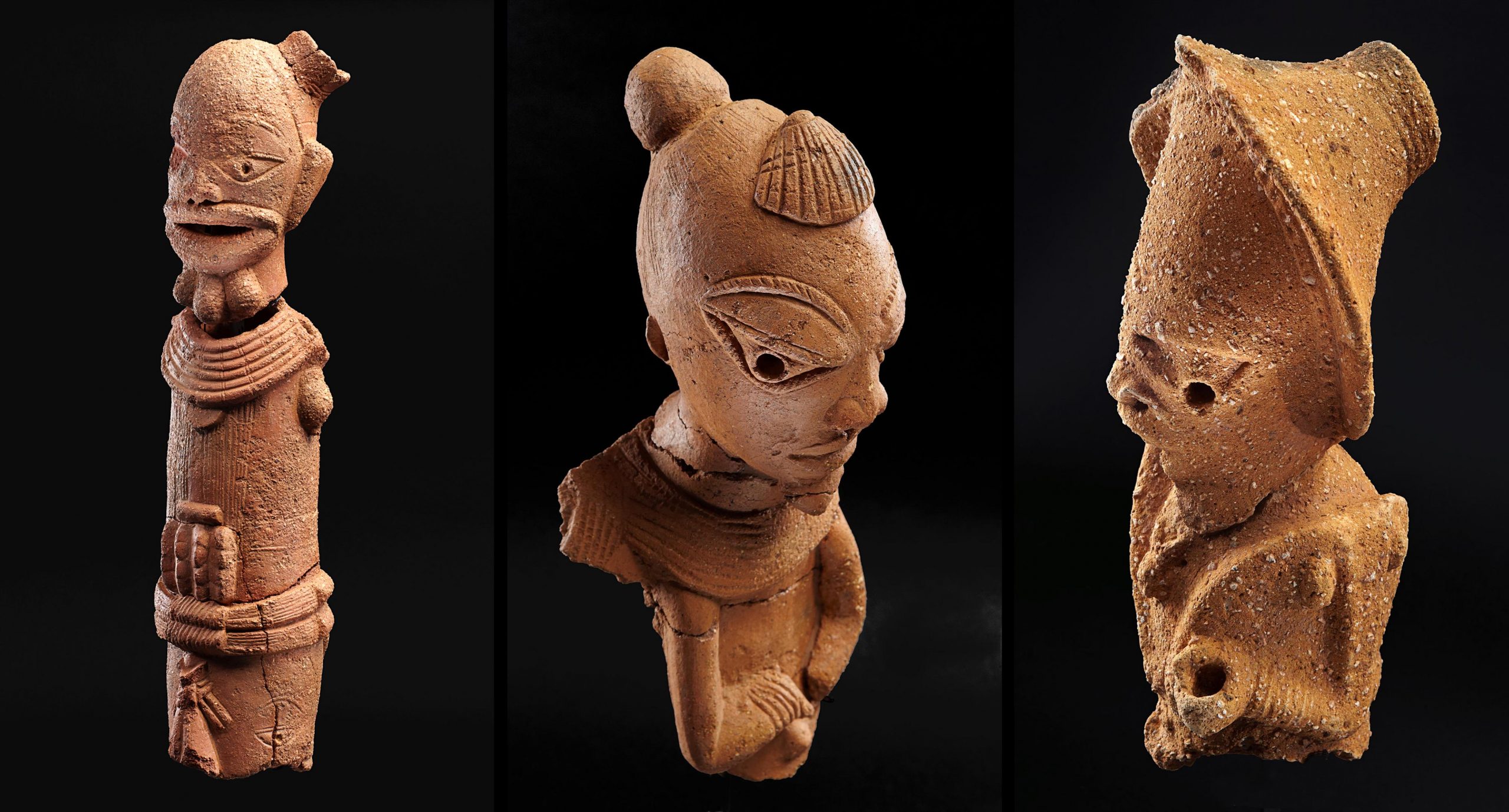
The Nok culture (or Nok civilization) is a group of people named after the Ham town of Nok in Nigeria’s Kaduna State, where its clay sculptures were discovered in 1928. The Nok Culture first originated in Nigeria around 1500 BC and lasted for almost 2,000 years, disappearing under mysterious circumstances around 500 AD.
It is thought to be the result of an ancestral nation that split into the Hausa, Gwandara people, Biram, Kanuri, and Nupe people.
Iron is used in smelting and forging implements in Nok civilisation in Africa as early as 550 BC, if not earlier. Iron smelting was known before 1000 BC, according to Christopher Ehret. The Dalla Hill in Kano was home to a Hausa community that migrated from Gaya and worked in the iron industry in the 7th century.
The purpose of the Nok terracotta statues is unknown. The terracotta is mostly conserved in the form of scattered bits. That is why Nok art is best recognized today for its heads, both male and female, with extremely detailed and sophisticated hairstyles. The statues are in pieces since most discoveries are found from alluvial mud in erosion-prone terrain.
The terracotta figures are hollow, coil built, nearly life sized human heads and bodies that are depicted with styled features, jewelry, and varied postures.
Not much has been found of the original function of the pieces, but theories include ancestor portrayal, grave markers, and charms to prevent crop failure, infertility, and illness. Also, based on the dome-shaped bases found on several figures, they could have been used as finials for the roofs of ancient structures.
Margaret Young-Sanchez, Associate Curator of Art of the Americas, Africa, and Oceania in The Cleveland Museum of Art, explains that, “most Nok ceramics were shaped by hand from coarse-grained clay and subtractively sculpted in a manner that suggests an influence from wood carving. After some drying, the sculptures were covered with slip and burnished to produce a smooth, glossy surface. The figures are hollow, with several openings to facilitate thorough drying and firing. The firing process most likely resembled that used today in Nigeria, in which the pieces are covered with grass, twigs, and leaves and burned for several hours”.
As a result of natural erosion and deposition, Nok terracottas were scattered at various depths throughout the Sahel grasslands, causing difficulty in the dating and classification of the mysterious artifacts. Luckily, two archaeological sites, Samun Dukiya and Taruga, were found containing Nok art that had remained unmoved. Many dates have been retrieved over time in the course of new archaeological excavations, extending the beginnings of the Nok tradition even further back in time.
Because of the similarities between the two sites, archaeologist Graham Connah believes that “Nok artwork represents a style that was adopted by a range of iron-using farming societies of varying cultures, rather than being the diagnostic feature of a particular human group as has often been claimed.”
Nok people may have developed terracotta sculptures through large-scale economic production. Among Nok terracotta sculptures at Pangwari, there are sculptures portraying a large teeth-bearing therianthropic (human-feline) figure and the torso of a seated figure wearing a belt around their waist and a necklace, which had added features (e.g., bows, knots); there are also sculptures portraying the head of a human figure that has a bird beak and the head of a male figure with a seashell on it, which may have been created by the same sculptor. Additionally, there are sculptures portraying figures wielding slingshots, as well as bows and arrows, which may be indicative of Nok people engaging in the hunting, or trapping, of untamed animals.
Some Nok sculptures portray two individuals, along with their goods, in a dugout canoe. Both, paddling. The Nok terracotta depiction of a dugout canoe may indicate that Nok people utilized dugout canoes to transport cargo, along tributaries (e.g., Gurara River) of the Niger River, and exchanged them in a regional trade network. The Nok terracotta depiction of a figure with a seashell on its head may indicate that the span of these riverine trade routes may have extended to the Atlantic Coast.
What To Expect At Nok Sites
In 1989, German scientists were working in northeastern Nigeria’s Chad Basin as part of a cooperative project between the University of Maiduguri located in Borno State, Nigeria, and archaeologists of Goethe University Frankfurt. This project examined the beginnings of sedentary farming societies in the Chad Basin. Questions arose about whether there were other societies like those in the Chad Basin, and these questions led the team to investigate the Nok Culture. In the early steps of the Frankfurt Nok Project, researchers had difficulty finding sites to excavate. The team began collaborating with Umaru Yusuf Potiskum and they started finding distinct Nok culture sites, although most were looted. A few sites, however, were still intact, and artefacts found at these sites are stated below
Stone tools
The shapes of stone tools found at Nok sites change little throughout the entire span of the Nok Culture. What tends to strike researchers is a lack of cutting tools. Apart from stone axes, no tools with a cutting edge have been found. Projectile points made of either iron or stone are also absent from Nok sites.
Grinding tools are very common at Nok sites. They are rarely preserved in one piece, but can still illustrate the different shapes and sizes of tools used throughout the Nok Culture. Grinding stones were made of quartzite, granitic, or metamorphic rock. At the site of Ungwar Kura, grinding stones seem to have been placed in a certain order, and at the site of Ido huge grinding slabs were arranged in an upright position with pots and stone beads next to them. This context is assumed to have been ritual in some way. Most of the grinders are merely hand-sized.
Stone rings have also been found at Nok Culture sites. They are normally found as fragments but can be identified as rings because of their flat, oval or triangular cross-sections and their shapes. These stone rings are very rare and their purpose is unknown, but their use as currency or a medium of exchange has been suggested. Another rare find is stone beads, which are typically found as if strung on strings. Beads tend to be carefully made out of hard siliceous rock such as quartz, chalcedony, jasper, or carnelian.
Ceramics
Potsherds (pottery shards) are the most abundant archaeological artifacts at Nok sites. Since 2009, excavated pottery has been undergoing systematic analysis with a central aim to try and establish a chronology. Certain attributes of the pottery such as decoration, shape, and size appear with an increasing frequency and then disappear, being replaced with different pottery attributes. This change can sometimes allow one to divide the progression into different intervals based on the different attributes.
To think years ago, it was nearly impossible to go back in time and experience ancient cultures. Now excavations through great archaeologists, have shown us the background of one the ancient cultures, that seemed to have lost its traces.
Stay tuned for more information on the features of these Nok sites that were excavated.
SOURCES
• Breunig, Peter. 2014. Nok: African Sculpture in Archaeological Context: p. 21.
• Fagg, Bernard. 1969. Recent work in west Africa: New light on the Nok culture. World Archaeology 1(1): 41–50.
• Breunig, Peter. 2014. Nok: African Sculpture in Archaeological Context: p. 51-59.
• Minze Stuiver and N.J. Van Der Merwe, ‘Radiocarbon Chronology of the Iron Age in Sub-Saharan Africa’ Current Anthropology 1968. Tylecote 1975 (see below)
• Breunig, P. (2014). Nok. African Sculpture in Archaeological Context. Frankfurt: Africa Magna
