



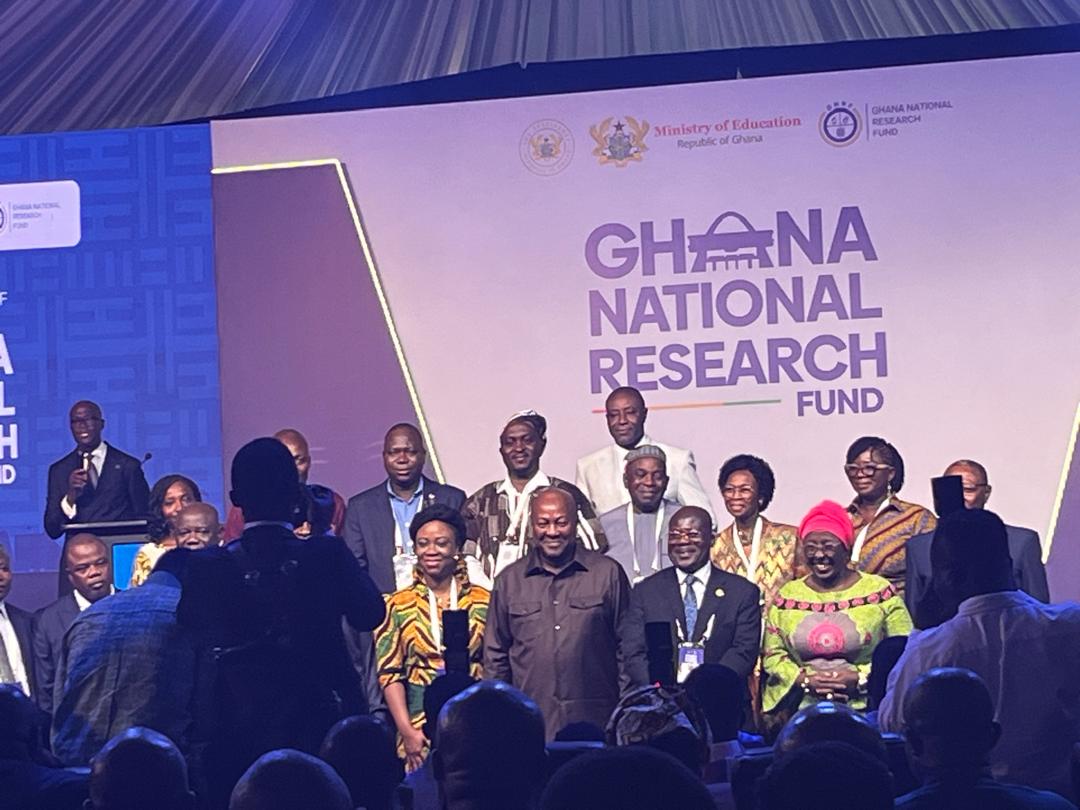
Ghana has taken a bold and potentially transformative step towards building a knowledge-driven economy, with the official launch of the Ghana National Research Fund at the Labadi Beach Hotel in Accra.
I had the privilege of representing the Executive Director of the Forum for Agricultural Research in Africa, Dr Aggrey Agumya, at this landmark national event. Dr Agumya leads FARA as Executive Director and Head of Mission, advancing the organisation’s continental mandate for agricultural research and innovation.
The launch, themed “Resetting Ghana: Financing Research for National Transformation,” was attended by the President of the Republic of Ghana, H.E. John Dramani Mahama; the Minister for Education, Hon. Haruna Iddrisu; the Deputy Minister for Education, Dr Clement Apaak; the Minister for Tourism, Culture and Creative Arts, Hon. Abla Dzifa Gomashie; and other high-level dignitaries.
Also present were representatives of the British High Commission, UNESCO, the World Bank, Parliament, Vice-Chancellors and senior members of universities and other research institutions, development partners, and other stakeholders in Ghana’s research and innovation ecosystem. The breadth of participation demonstrated that research financing is no longer the sole concern of universities and laboratories. It is increasingly recognised as a national development imperative.
From Commitment to Catalytic Investment
A defining moment of the launch was President Mahama’s announcement of an immediate GH¢100 million catalytic allocation to support the Fund’s operationalisation in 2026. The President further pledged his direct support for the Fund’s broader resource mobilisation agenda.
The allocation is expected to support competitive research grants, doctoral and postdoctoral programmes, digital grant-management infrastructure, and innovation initiatives aligned with Ghana’s national development priorities. The President also directed the Ministry of Education, GETFund, and the GNRF Governing Board to ensure the transparent, accountable, and results-oriented use of the resources.
This commitment is both significant and timely. For decades, research funding in Ghana has been fragmented, unpredictable and heavily reliant on external funding. Such dependence can distort research priorities, disrupt long-term programmes and weaken the ability of national institutions to investigate problems requiring sustained attention.
The Ghana National Research Fund, established under the Ghana National Research Fund Act, 2020 (Act 1056), provides a statutory framework for mobilising, managing and allocating sustainable funding for research, innovation, technology development and research infrastructure across the sciences, humanities and other fields of national endeavour.
The Fund’s governing documents appropriately characterise research financing as national infrastructure rather than a discretionary expenditure. They identify five national research missions for 2026–2030: food-systems transformation; climate and environmental sustainability; health innovation and biosecurity; digital and industrial transformation; and governance, policy and social systems.
These priorities recognise that research must ultimately improve productivity, livelihoods, public services, resilience and national competitiveness.
Strong Institutional Foundations
The Chair of the Governing Board, Professor Eric Yirenkyi Danquah, highlighted the Fund’s institutional progress to date, including the development of its five-year strategic framework for 2026–2030 and the acquisition of office premises in East Legon, Accra.
The strategy sets out a vision for building a world-class research and innovation fund capable of powering Ghana’s transformation. Its priorities include research talent development, transparent, competitive funding, innovation and industry partnerships, evidence-informed policymaking, sustainable financing, and institutional strengthening.
These are strong foundations. However, the Fund’s long-term success will be judged not only by how much money it mobilises, but also by the quality, accessibility and practical utility of the knowledge generated through its investments.
Knowledge Management Must Be Built Into the Fund
For the GNRF to deliver sustained national impact, knowledge management must be embedded in its design and operations from the beginning.
Research funding should not end when a project report is submitted or a journal article is published. The Fund must support the entire knowledge-to-impact pathway: identifying national knowledge needs, generating and validating evidence, documenting findings, preserving research outputs, translating technical evidence into accessible formats, sharing knowledge with relevant users, and tracking its application.
A robust knowledge-management architecture would help the Fund avoid duplication, connect researchers working on related challenges, retain institutional memory, and make previous findings accessible to new research teams. It would also enable government, industry, farmers, civil society organisations, and communities to use research evidence more effectively.
This will require interoperable institutional repositories, national research directories, communities of practice, open-access publishing mechanisms, data-governance standards, and systems for capturing lessons from both successful and unsuccessful research investments.
Recognition and incentive systems will also be essential. Researchers should be recognised not only for publications in academic journals but also for data sharing, policy engagement, public communication, interdisciplinary collaboration, mentorship, and demonstrable contributions to social and economic transformation.
Connecting Science with Open Knowledge
The Fund should explore strategic collaboration between Ghanaian scientists and established open-knowledge platforms and communities, including the Wikimedia movement.
Such collaboration could make verified Ghanaian research more discoverable and usable for citizens, students, journalists, policymakers and practitioners. Researchers could collaborate with open-knowledge professionals to improve publicly accessible information on Ghanaian crops, biodiversity, health innovations, climate systems, cultural assets, technologies and historical scientific contributions.
This is not a call to replace scholarly publishing or to compromise research integrity. It is an opportunity to complement academic communication with carefully governed, multilingual, and publicly accessible knowledge products.
A publicly financed research system must consider how its outputs can benefit the widest possible range of users. Appropriate safeguards would, of course, be required to protect personal data, intellectual property, sensitive ecological information, national security and commercially valuable innovations.
The objective should be responsible openness: making knowledge as open as possible while protecting information that must legitimately remain restricted.
Indigenous Knowledge Must not be Marginalised
Ghana’s research future cannot be built solely around formal scientific institutions while neglecting the accumulated knowledge of farmers, fisherfolk, pastoralists, traditional healers, artisans, processors and local communities.
Indigenous and local knowledge systems have long supported seed selection, soil management, biodiversity conservation, weather interpretation, food processing, natural resource governance and community health. They are particularly important for climate adaptation and food systems resilience.
The GNRF should therefore support research models that bring scientists and communities together as partners in co-creation of knowledge. Indigenous knowledge holders should not merely be treated as respondents from whom information is extracted. They should participate in defining research questions, interpreting findings, and determining how resulting knowledge and benefits are used.
Clear ethical protocols will be required to ensure prior informed consent, appropriate attribution, protection against misappropriation, and equitable benefit-sharing. This would enable the Fund to strengthen scientific inquiry while respecting Ghana’s intellectual and cultural heritage.
Gender-Responsive and Inclusive Research Financing
The Fund also has an opportunity to address structural inequalities within the national research ecosystem.
Its competitive funding mechanisms should deliberately expand opportunities for women scientists, early-career researchers, people with disabilities, researchers outside the largest universities, and innovators working in underserved regions. Gender sensitivity should not be reduced to counting the number of women participating in research projects.
Funding assessments should examine whether research questions, methodologies, teams and intended benefits adequately reflect the diverse realities of women, men, young people and marginalised groups.
Transparent peer-review systems, mentorship programmes, career re-entry support, accessible application processes and disaggregated monitoring data would help the Fund build a more inclusive national research community. Excellence and inclusion should reinforce each other rather than compete.
FARA Stands Ready To Partner
The establishment of the GNRF is directly relevant to FARA’s continental mandate. FARA is Africa’s apex organisation for coordinating and advocating for agricultural research and innovation. It serves as a technical arm of the African Union Commission and the African Union Development Agency on agricultural science, technology and innovation.
FARA therefore applauds the Government of Ghana for this exemplary, bold and visionary initiative.
Of particular importance to FARA is the recognition of food-systems transformation as one of the Fund’s five national missions. Ghana’s agricultural sector faces interconnected pressures from climate variability, land degradation, post-harvest losses, shifting diets, youth unemployment, limited value addition and unequal access to technology. These challenges require coordinated, adequately financed research that links agriculture to nutrition, markets, the environment, digitalisation and social policy.
FARA stands ready to collaborate with the GNRF on areas including agricultural research priority-setting, knowledge management, institutional capacity development, foresight, research-to-policy engagement, innovation scaling, digital knowledge infrastructure, and the mobilisation of continental and international partnerships.
Through its relationships with national agricultural research systems, subregional organisations, universities, farmer organisations, development partners and the African Union, FARA can also help link Ghana’s experience to wider African learning and cooperation.
The objective should not be simply for Ghana to adopt models developed elsewhere. Ghana can build a credible national institution whose experience can serve as a learning point for other African countries seeking sustainable, nationally owned research-financing systems, similar to what the government of South Africa is doing through the National Research Fund (NRF).
A Continental Opportunity
Across Africa, persistent underfunding of research has constrained scientific sovereignty and reinforced dependence on externally developed technologies, evidence and policy solutions. President Mahama rightly emphasised that economic sovereignty cannot be separated from a nation’s capacity to generate knowledge and solutions to its own challenges.
The GNRF can help reverse this pattern, but sustained success will require more than an initial allocation. Government financing must be predictable. Industry must invest in research partnerships. Philanthropy and development partners must align with nationally defined priorities. Universities must strengthen accountability and interdisciplinary collaboration. Researchers must communicate beyond academic audiences. Communities must have a meaningful voice in shaping research agendas.
Equally important, the Fund must be protected from political interference and short-termism. Competitive awards should be governed by transparent criteria, rigorous peer review, public reporting, and credible conflict-of-interest safeguards.
Turning a National Milestone into Lasting Transformation
The launch of the Ghana National Research Fund marks an important national achievement. The President’s GH¢100 million commitment provides vital initial momentum, while the Fund’s strategy, governance arrangements and national missions set a promising direction.
The next task is to convert this momentum into a durable institution that supports excellent research, values all legitimate knowledge systems, and ensures that evidence reaches the people and institutions able to apply it.
By embedding knowledge management, responsible open knowledge, indigenous knowledge, gender equality, accountability and strategic partnerships into its operations, the GNRF can become more than a financing institution. It can become a central pillar of Ghana’s national transformation and a model for the African continent.
FARA congratulates the Government and people of Ghana, the Ministry of Education, and the Governing Board and management of the Ghana National Research Fund on this historic milestone. We stand ready to contribute to the Fund’s success and to help translate Ghana’s experience into shared learning on agricultural research, innovation and knowledge-driven development across Africa.
Written By: Benjamin Abugri (Lead Specialist for Knowledge Management, Digitalisation and Learning at the Forum for Agricultural Research in Africa)
