







|
Getting your Trinity Audio player ready...
|
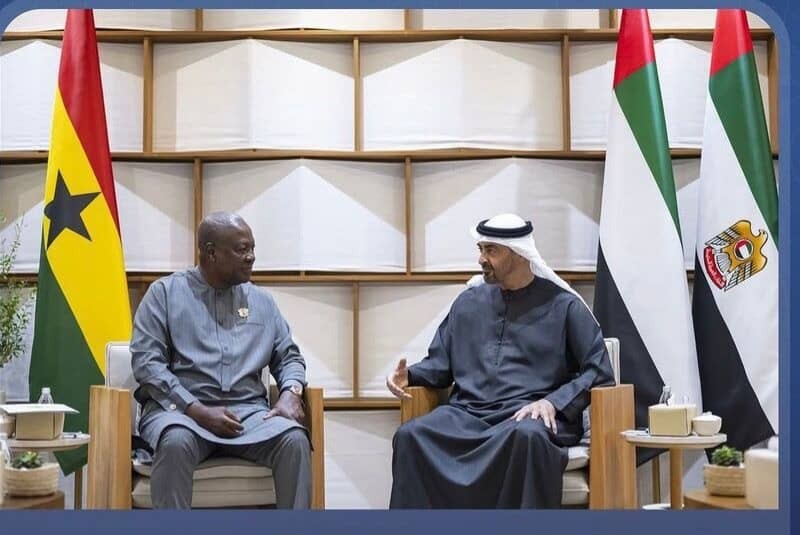
Relations between Ghana and United Arab Emirates entered a renewed phase of strategic cooperation after President John Dramani Mahama held high-level discussions with UAE President Sheikh Mohamed bin Zayed Al Nahyan during the “Make it in the Emirates 2026” summit in Abu Dhabi on Wednesday, 6th May 2026.
The diplomatic engagement, which took place on the sidelines of the international investment and industrial summit at the Abu Dhabi National Exhibition Centre, focused heavily on energy security, investment expansion, infrastructure cooperation, and technological innovation. The meeting is being viewed by analysts as an important step in Ghana’s efforts to attract Gulf investment into critical sectors of its economy while diversifying its international economic partnerships.
At the center of the discussions was a proposal for UAE-backed investment into Ghana’s oil and gas storage infrastructure. Both governments explored opportunities for the UAE to support the development of strategic petroleum and gas storage facilities in Ghana, a move that could significantly improve Ghana’s energy resilience and regional energy distribution capacity.
The proposed investment is particularly important for Ghana at a time when many African countries are seeking to strengthen domestic energy security while reducing vulnerability to global fuel supply disruptions. Ghana’s growing industrialization agenda and increasing energy demand have heightened the need for expanded storage and distribution infrastructure. UAE participation in this sector would provide not only capital investment but also technical expertise from one of the world’s leading energy economies.
Beyond traditional oil and gas cooperation, the meeting also reflected a broader shift toward energy diversification and sustainability. President Mahama and Sheikh Mohamed discussed cooperation in Liquefied Natural Gas (LNG), renewable energy, and solar power development. The leaders emphasized the importance of transitioning toward cleaner and more sustainable energy systems while maintaining energy affordability and reliability.
The emphasis on LNG and solar energy aligns with Ghana’s long-term energy transition objectives. Ghana has increasingly sought to reduce overdependence on crude oil while expanding renewable energy generation and improving electricity reliability. The UAE, which has invested heavily in renewable energy projects globally through institutions such as Masdar and other state-backed investment vehicles, is positioning itself as a strategic partner for emerging economies seeking sustainable energy transformation.
The talks also extended beyond energy into trade, innovation, artificial intelligence, and technology cooperation. According to statements released after the meeting, both countries expressed commitment to deepening bilateral economic ties in sectors capable of driving long-term growth and industrial modernization.
For Ghana, closer relations with the UAE could open new opportunities in infrastructure financing, logistics, smart technologies, and digital transformation. The UAE has become one of the Gulf region’s most influential investment hubs, with significant interests across Africa in ports, logistics, aviation, telecommunications, and renewable energy. Ghana’s political stability and democratic credentials continue to make it attractive to foreign investors seeking entry points into West Africa.
During the discussions, Sheikh Mohamed reportedly described Ghana as a “peaceful partner” and a “secure, stable democracy,” highlighting confidence in Ghana’s investment environment and economic potential.
The meeting also took place against the backdrop of growing geopolitical tensions in the Middle East, particularly concerns surrounding hostilities involving the United States and Iran. Both leaders acknowledged the wider implications of instability in the Gulf region on global energy markets and economic development. They expressed hope for a peaceful resolution to regional conflicts so that international attention could return to sustainable development and innovation.
Diplomatic observers note that Ghana’s engagement with the UAE reflects a broader strategy of strengthening ties with Gulf states that possess strong sovereign wealth funds and global investment influence. In recent years, Gulf countries have expanded their economic footprint across Africa through investments in energy, agriculture, transport infrastructure, mining, and digital economies.
The UAE in particular has emerged as one of Africa’s major external investors, leveraging institutions based in Abu Dhabi and Dubai to finance large-scale projects across the continent. Ghana’s renewed engagement therefore positions it to benefit from increased foreign direct investment, technology transfer, and trade cooperation.
The Abu Dhabi meeting between President Mahama and Sheikh Mohamed bin Zayed ultimately underscored a shared commitment to transforming diplomatic goodwill into practical economic collaboration. While many of the discussions remain at the framework stage, the proposed partnerships in oil storage infrastructure, LNG, renewable energy, technology, and investment signal a potentially significant chapter in Ghana-UAE relations.
Implications for Ghana’s Economy
If the proposed partnerships and investment discussions materialize into formal agreements, Ghana could position itself as a strategic investment destination in West Africa and benefit significantly in several areas:
Expansion of Strategic Oil and Gas Infrastructure
The proposed partnership between Ghana and the UAE could significantly improve Ghana’s oil and gas infrastructure, especially in the area of fuel storage and distribution. Ghana has often faced challenges linked to fuel supply fluctuations and rising energy demand. By investing in modern storage facilities and logistics systems, the UAE can help Ghana build stronger energy reserves that will support industries, transportation, and households. Improved infrastructure would also position Ghana as a reliable energy distribution center within West Africa, increasing regional trade opportunities and strengthening economic resilience.
Increased Foreign Direct Investment
Closer diplomatic and economic relations with the UAE could open the door for larger volumes of foreign direct investment into Ghana’s economy. Investors from the Gulf region are increasingly looking toward African markets with stable political systems and growth potential. Ghana’s democratic environment makes it attractive for long-term investment in sectors such as energy, technology, transport, tourism, and manufacturing. Increased investment would provide capital for development projects, improve business activities, and stimulate economic growth. It could also encourage other international investors to view Ghana as a secure destination for business expansion.
Job Creation in Energy and Industrial Sectors
One of the most important benefits of the partnership is the potential creation of employment opportunities for Ghanaians. Large-scale energy and infrastructure projects require engineers, technicians, construction workers, project managers, and support staff. As new facilities and industries emerge through UAE investment, more direct and indirect jobs could become available. This would especially benefit young people seeking employment in technical and industrial sectors. Beyond immediate construction jobs, long-term operations and maintenance activities would also provide sustainable employment opportunities while helping improve local skills and workforce development.
Technology and Knowledge Transfer
The collaboration between Ghana and the UAE is not only about financial investment but also about sharing technical expertise and modern technology. The UAE has developed advanced systems in energy management, logistics, renewable energy, and smart infrastructure. Through partnerships and joint projects, Ghanaian professionals could gain exposure to modern industrial practices and technological innovations. This transfer of knowledge would help strengthen local institutions and improve operational efficiency across sectors. Over time, Ghana could build stronger technical capacity and reduce dependence on external expertise for future development projects.
Improved Energy Reliability and Sustainability
Reliable energy remains essential for economic growth, industrial productivity, and improved living standards. Through cooperation in LNG, renewable energy, and solar power projects, Ghana could strengthen its energy supply while reducing frequent power-related challenges. The focus on cleaner energy sources also supports global efforts toward environmental sustainability and climate resilience. Stable electricity supply would benefit businesses, hospitals, schools, and households across the country. In the long term, investment in sustainable energy systems could lower operational costs, improve productivity, and support Ghana’s broader industrialization and economic transformation agenda.
Enhanced Regional Trade and Logistics Capacity
The development of modern energy and infrastructure systems could improve Ghana’s position as a trade and logistics hub within West Africa. Better storage facilities, transportation systems, and industrial investments would support the movement of goods and services across neighboring countries. Ghana’s strategic coastal location already gives it an advantage in regional commerce, and stronger infrastructure could attract more international trade activity. Increased logistics capacity would support exports, improve supply chain efficiency, and strengthen regional economic integration. This would ultimately contribute to higher government revenue, stronger businesses, and broader economic growth opportunities.
How the Meeting Strengthens Africa-Gulf Relations
The recent high-level meeting between Ghana and the United Arab Emirates reflects the growing importance of Africa-Gulf relations in today’s global economy. Discussions between President John Dramani Mahama and Sheikh Mohamed bin Zayed Al Nahyan focused on energy cooperation, infrastructure investment, renewable energy, technology, and trade expansion. The meeting highlights how African and Gulf countries are moving beyond traditional diplomatic ties toward more practical economic partnerships.
For African countries like Ghana, stronger Gulf relations provide opportunities to attract investment, improve infrastructure, create jobs, and support industrial growth. Gulf nations such as the UAE possess strong financial resources and are increasingly investing across Africa in sectors including energy, transport, logistics, and digital innovation. In return, Africa offers growing markets, natural resources, and strategic economic opportunities.
The engagement also demonstrates a shift toward mutually beneficial cooperation rather than dependence on traditional Western partners. Ghana’s political stability and democratic reputation continue to attract investor confidence from Gulf states. Ultimately, partnerships like this can improve economic development, strengthen regional cooperation, and create long-term opportunities that positively impact ordinary citizens across both regions.
Conclusion
The recent diplomatic engagement between President John Dramani Mahama and UAE President Sheikh Mohamed bin Zayed Al Nahyan marks an important step in the evolving relationship between Ghana and the United Arab Emirates. While many of the discussions remain at the framework and negotiation stage, the meeting demonstrated a shared commitment to transforming diplomatic goodwill into practical economic cooperation. With growing collaboration in energy, renewable power, infrastructure, technology, and investment, the Ghana-UAE partnership may become one of the most strategically important bilateral relationships for Ghana’s economic transformation agenda in the coming years.


