


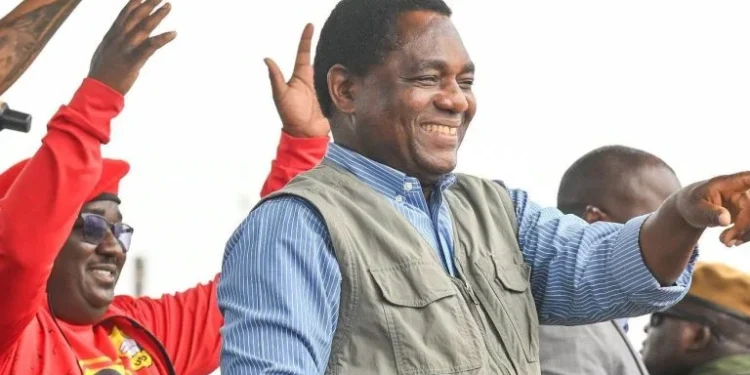
Zambia’s President Hakainde Hichilema has been re-elected for a second five-year term after securing 60% of the vote, according to the country’s Electoral Commission.
His closest challenger, Brian Mundubile, received 38% of the votes, while the remaining 12 candidates trailed far behind.
The election result follows a contested process, with Mundubile earlier claiming victory and alleging voting irregularities without providing evidence. His party, the NRPUP, told the BBC that he was in a “secure location under the protection of an international human rights body” following alleged threats against him.
The development came after several prominent opposition figures were arrested during a raid on Friday, August 14, with authorities accusing them of plotting an insurrection. Mundubile dismissed the allegation as a fabrication.
In his victory speech, 64-year-old Hichilema expressed gratitude to voters and described the election as evidence that Zambia remains a peaceful and democratic country.
“We are truly humbled by the trust you have placed in our hands,” he said.
He added that Zambia was a nation that settles political differences “at the ballot box, and nowhere else.”
Hichilema also appealed to citizens who supported his opponents, promising that his government would continue working for them.
Following the declaration, hundreds of supporters of Hichilema’s United Party for National Development (UPND), dressed in the party’s red colours, took to the streets of the capital to celebrate.
Zambia has a longstanding record of peaceful transfers of power, with presidential transitions taking place through elections since the country returned to multiparty democracy in 1991.
Opposition Raises Concerns
It remains unclear whether the opposition will formally challenge the election result.
Mundubile had alleged discrepancies between polling-station results and those announced officially and also claimed there had been military involvement at tallying centres.
On Monday, August 17, he described the raid on his home in Lusaka, alleging that armed personnel used an armoured vehicle to break through the gate, damaged doors and windows and opened fire.
He denied claims by authorities that high-grade military weapons and a militia were being kept at his residence.
“So they came in to kill us,” he told the BBC.
However, Mulambo Haimbe, Hichilema’s election agent and a senior UPND member, rejected Mundubile’s account as inaccurate.
He said criminal charges were being pursued against those arrested and that the courts would determine the relevant issues if the opposition decided to challenge the election outcome.
The Electoral Commission briefly suspended the counting and announcement of results a day after voting, citing reports of violence against polling officials and the theft of marked ballot papers. The suspension was lifted later the same day.
Observers Raise Concerns
Regional and international observers described election day as largely peaceful and urged political actors to remain calm and respect the official electoral process.
However, observers raised concerns about late electoral reforms, media freedom and access to the media during the campaign period.
Samuel Tembenu, a former Malawian minister who led the Southern African Development Community (SADC) observer mission, said the team had recorded, but could not verify, reports of intimidation, assault, abduction and property damage in five provinces.
Observers also expressed concern over the temporary suspension of vote counting, warning that it could undermine the credibility of the electoral process and public confidence.
The European Union election observation mission further warned that restrictions placed on opposition parties during the campaign period may have contributed to what it described as an “uneven contest.”
Source: citinews
