



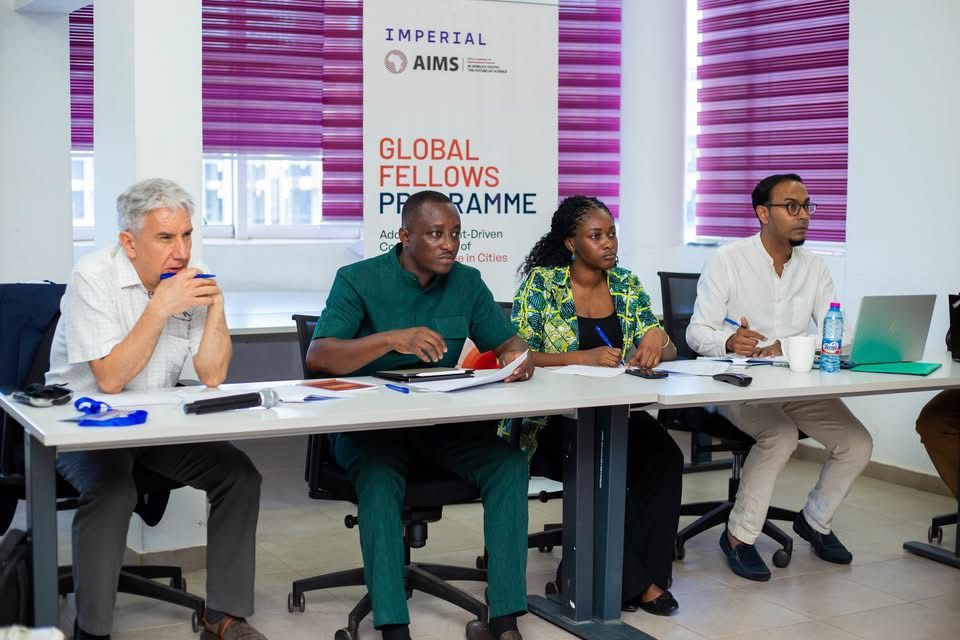
African Institute for Mathematical Sciences, in collaboration with Imperial College London’s Early Career Researcher Institute (ECRI), has successfully hosted the fourth edition of the Imperial–AIMS Global Fellows Programme (GFP) 2026, bringing together doctoral researchers to develop innovative solutions to the growing challenge of extreme urban heat caused by climate change.
Held from June 1 to 5, 2026, the programme attracted 40 doctoral researchers from Imperial College London, AIMS, the University of Ghana, and the University of Health and Allied Sciences. The initiative was designed to promote interdisciplinary collaboration, innovation, and practical problem-solving.
This year’s programme centred on the theme, “Addressing Heat-Driven Consequences of Climate Change in Cities,” encouraging participants to design scalable and practical interventions that can strengthen urban resilience in Africa and other regions facing similar challenges.
The event opened with remarks from Programme Co-Directors, Helal Ahmed and Angela Tabiri, who guided participants through networking sessions, team-building exercises, and collaborative activities aimed at fostering effective interdisciplinary partnerships.
Participants also benefited from expert-led discussions featuring climate and development specialists, including Portia Adade Williams, Frederick Otu-Larbi, Mouhamadou Bamba Sylla, and Augustine Owusu-Ansah. Their presentations explored climate science, urban development, and resilience strategies, helping participants identify key challenges and opportunities.
A major component of the programme included a study visit to the Accra Metropolitan Assembly, where fellows gained practical insights into urban governance and climate-related policymaking. Participants also visited the Kwame Nkrumah Memorial Park to reflect on themes of leadership, nation-building, and sustainable development.
As the programme progressed, teams moved from identifying challenges to designing innovative solutions. Through workshops focused on creativity, innovation, communication, and academic career development, participants refined project ideas aimed at addressing the impacts of extreme heat in urban environments.
The programme concluded with an accelerator challenge in which five teams presented their solutions before a panel that included Prince Koree Osei, Majid Ezzati, and Rhoda Nana Safowa.
Team PUMCLID emerged as the overall winner with its project, “Comprehensive Early Warning System: Act Beyond the Warning.” The proposal addressed the increasing threat of extreme heat in cities such as Accra through an integrated approach combining enhanced early warning systems, solar-powered cooling shelters, and an electricity-free wearable cooling device. The project also emphasized community engagement and effective communication to ensure that heat warnings translate into timely action.
The Popular Choice Award went to Team MiniForest for its project, “An Integrated Natural Shading and Heat Monitoring/Warning System.” The initiative proposed combining small-scale urban tree-planting projects with heat and air-quality monitoring technologies to improve living conditions and support vulnerable populations.
Organisers said the programme once again demonstrated the value of interdisciplinary collaboration in addressing complex global challenges. By bringing together emerging researchers from diverse backgrounds, the Global Fellows Programme continues to nurture future leaders and innovators dedicated to advancing climate resilience and sustainable development.
The week-long event concluded with a celebratory gathering featuring food, music, and games, marking the end of a productive and inspiring programme while laying the foundation for innovative climate solutions with the potential for real-world impact.
Source: 3news
