



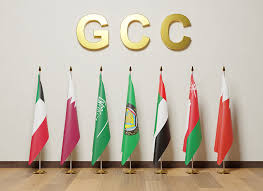
The Gulf Cooperation Council (GCC), comprising Saudi Arabia, the United Arab Emirates
(UAE), Qatar, Kuwait, Bahrain, and Oman, has significantly increased its engagement with
Africa in recent years. This expansion is driven by economic diversification, strategic
investments, and a growing interest in Africa’s natural resources, infrastructure, and markets.
As GCC nations seek to reduce their dependence on oil, Africa presents new opportunities for
trade, investment, and geopolitical influence.
GCC-Africa Trade Relations
Trade between GCC countries and Africa has grown substantially, with a focus on energy,
food security, and manufacturing. Key aspects of this relationship include:
Energy Trade: The GCC-Africa energy relationship is driven by both oil exports and
renewable energy collaborations. Africa is a key crude oil supplier to the GCC, with Nigeria
exporting over 100,000 barrels per day to the UAE and Saudi Arabia. On the other hand, the
GCC provides refined petroleum products and gas to African nations. In 2022, the UAE’s
ADNOC supplied over $1.2 billion worth of refined petroleum to Africa, ensuring energy
security in countries like Egypt, Kenya, and South Africa. Additionally, Saudi Aramco has
initiated discussions for joint refinery projects in Africa to reduce energy import dependency.
Food Security: Africa’s vast agricultural lands are a key focus for GCC countries, which
import large quantities of food to meet domestic demand. The UAE, through Agthia Group
and Al Dahra, has invested over $500 million in Sudan, Ethiopia, and Egypt to secure grain
and livestock production. Saudi Arabia’s SALIC (Saudi Agricultural and Livestock
Investment Company) has acquired farmlands in Sudan and invested over $1.3 billion in food
production projects across Africa to ensure stable food supply chains. In 2023, Africa
accounted for nearly 30% of Saudi Arabia’s imported grains and livestock.
Manufacturing & Logistics: Ports in Djibouti, Kenya, and Tanzania are becoming critical
for Gulf investors looking to expand supply chain networks. The UAE’s DP World has
invested over $2 billion in African ports, including the expansion of the Berbera Port in
Somaliland and the development of logistics hubs in Senegal and Egypt. In 2022, DP World
handled over 12 million TEUs (twenty-foot equivalent units) of cargo across Africa,
enhancing trade connectivity. Saudi Arabia’s Public Investment Fund (PIF) has also
announced plans to invest $1 billion in African logistics and transport infrastructure to
support manufacturing growth.
Strategic Investments by GCC Nations
Infrastructure &Transport: GCC investments in Africa’s transport and infrastructure sectors are growing rapidly. The UAE’s DP World, a major player in African port operations, has invested over $1 billion in upgrading ports in Senegal, Egypt, and Somaliland. The UAE and Saudi Arabia have also pledged funding for road and rail projects, including the $3 billion Lapsset Corridor Project in Kenya, enhancing regional connectivity. The expansion of Tanger Med Port in Morocco, backed by Gulf investors, has positioned it as Africa’s largest shipping hub, handling over 7 million containers annually.
Energy & Renewable Projects: The GCC is driving Africa’s renewable energy transition,
with Masdar (UAE) leading solar and wind projects across the continent. In 2023, Masdar
announced a $10 billion investment plan in Egypt, aiming to develop 10 GW of renewable
energy capacity. Saudi Arabia’s ACWA Power is constructing a $500 million solar power
plant in South Africa, contributing to the country's shift from coal-based energy. Qatar has
also entered the renewable energy space, with its Qatar Investment Authority (QIA) investing
$2 billion in African solar and wind farms, particularly in Sudan and Ethiopia.
Mining & Natural Resources: Africa’s rich mineral resources have attracted significant
GCC investments, particularly in gold, copper, and lithium. Saudi Arabia’s Ma’aden, one of
the world’s largest mining companies, has partnered with African nations to explore gold
mining in Sudan and Mauritania. UAE-based companies have invested over $5 billion in
Africa’s lithium mining sector, particularly in the Democratic Republic of Congo and
Zimbabwe, securing key raw materials for electric vehicle production. Qatar is also investing
in Africa’s gas sector, committing $3 billion to Mozambique’s LNG projects, reinforcing its
role as a global energy powerhouse.
Real Estate &Tourism: The GCC’s investment in Africa’s real estate and tourism sectors is
surging. Dubai-based Emaar Properties has launched luxury hotel and residential projects in
Egypt, Morocco, and Kenya, worth over $4 billion. Saudi Arabia’s Public Investment Fund
(PIF) is backing tourism projects in South Africa and the Seychelles, aligning with its Vision
2030 tourism expansion strategy. Qatar’s Katara Hospitality has acquired stakes in several
five-star hotels in Cairo and Zanzibar, aiming to boost the region’s appeal as a high-end
tourism destination. These investments are enhancing Africa’s real estate landscape and
driving economic growth.
Geopolitical Influence & Strategic Partnerships
GCC nations are leveraging their economic power to strengthen political ties with African
nations. Key aspects include:
Military and Security Cooperation: The UAE and Saudi Arabia have established military
bases in Djibouti and Eritrea, securing strategic locations along the Red Sea. In 2023, Saudi
Arabia announced a $1 billion defence cooperation deal with African nations to enhance
regional security. The UAE has also provided military aid to counterterrorism operations in
Somalia and the Sahel, strengthening its regional influence and securing maritime trade
routes.
Soft Power Diplomacy: GCC countries are expanding their influence through cultural and
educational programs. Saudi Arabia funds scholarships for thousands of African students in
Riyadh and Jeddah, while Qatar’s Education Above All foundation has helped educate over
10 million children in Africa. The UAE’s humanitarian efforts include a $500 million aid
package for African countries affected by drought and food shortages in 2023.
Multilateral Collaborations: The Gulf states are deepening relations with African organizations like the African Union (AU) and ECOWAS. In 2023, the UAE pledged $4.5 billion for Africa’s clean energy projects at the COP28 summit. Saudi Arabia also signed new agreements with South Africa and Kenya to enhance trade and investment, reinforcing its economic and diplomatic ties with key African markets.
Challenges & Future Prospects
Despite growing engagement, challenges remain, including political instability in some African nations, regulatory hurdles, and competition from China and Western investors. However, as GCC countries continue diversifying their economies, Africa will remain a key region for trade and investment. GCC member, Saudi Arabia has big plans for investing in Africa, with a commitment to provide at least $41 billion in funding for low-income sub-Saharan countries over the next decade. This investment will be spread across various sectors:
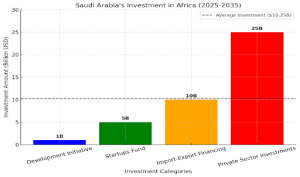
Saudi Arabia’s investment in Africa over the next decade. The private sector investment is the
largest at $25 billion, followed by trade financing at $10 billion financing from the Saudi
Import-Export Bank, providing access to capital for African businesses, Startups support at
$5 billion, and the development initiative at $1 billion focusing on sustainable development
and economic growth.
Trend Analysis: The average investment across all categories is $10.25 billion, indicated by
the dashed line. Private sector investments dominate (61% of total funding), showing Saudi
Arabia’s strong interest in infrastructure, energy, and agriculture. Startups and trade financing
receive significant support, emphasizing economic growth through entrepreneurship and
business expansion. Sustainable development gets the least allocation ($1B), suggesting more
room for policy engagement to enhance social programs.
Saudi Arabia’s state-owned oil company, Aramco, is also exploring investment opportunities
in Africa, particularly in the energy sector. Additionally, ACWA Power, a Saudi-based
company, has already invested over $7 billion in Africa and plans to further expand its
footprint on the continent. These investments are part of Saudi Arabia's broader strategy to
strengthen its economic ties with Africa and promote sustainable development on the
continent.
Conclusion
The GCC’s expanding footprint in Africa is shaping the continent’s economic landscape.
With increasing investments in trade, infrastructure, and energy, Gulf nations are poised to
become long-term partners in Africa’s growth. Moving forward, strengthened diplomatic and
economic relations will further cement the GCC’s role as a key player in Africa’s
development.
