



|
Getting your Trinity Audio player ready...
|
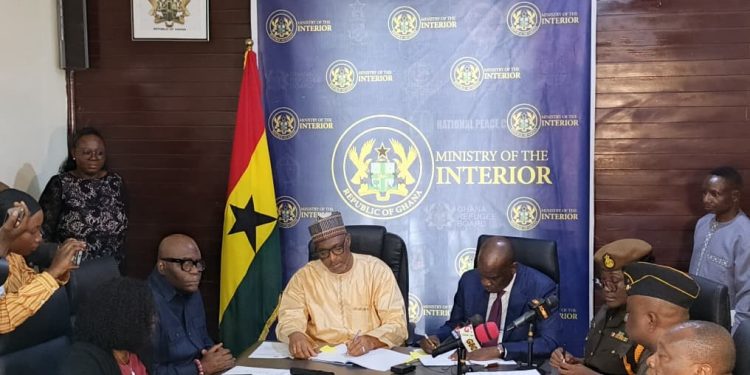
The Ministry of the Interior and the Ministry of Education have signed a Memorandum of Understanding (MoU) to facilitate the production of school uniforms, furniture and 12 million sanitary pads for schools across the country.
Under the agreement, the Ghana Prisons Service will play a central role in the initiative, with the MoU providing a minimum 30 percent concession for the production and supply of school furniture and a minimum 25 percent concession for the implementation of the government’s 2025 Free Sanitary Pad Initiative.
Speaking at the signing ceremony, the Minister for the Interior, Muntaka Mohammed Mubarak, said the agreement would ensure value for money, enhance transparency and promote local production within state-owned institutions.
“We will ensure value for money and transparency in public procurement by anchoring production within state-owned industrial systems, subject to clear oversight,” he said.
The Director-General of the Ghana Prisons Service, Patience Baffoe-Bonnie, said the initiative would also contribute significantly to reducing recidivism by equipping inmates with employable skills and opportunities.
“Apart from helping inmates to be law-abiding while in prison and creating the opportunity for them to earn income, the ultimate goal is to ensure that the public is safe,” she said.
“If this cycle is completed, what it means is that we are going to break the cycle of recidivism, and people who come to us will be released to live law-abiding lives.”
For his part, the Minister for Education, Haruna Iddrisu, disclosed that the initiative aims to produce over 12 million sanitary pads and assured that adequate budgetary support would be provided to enable the Ghana Prisons Service to meet the target.
“We will find the appropriate budget line to support the Ghana Prisons Service to undertake the production of these sanitary pads. Going into 2026, we will be mindful and guided by this MoU when undertaking procurement,” he said.
The initiative is expected to support local production, improve access to essential school supplies, and contribute to rehabilitation and skills development within the prison system.
Source: citinews
