



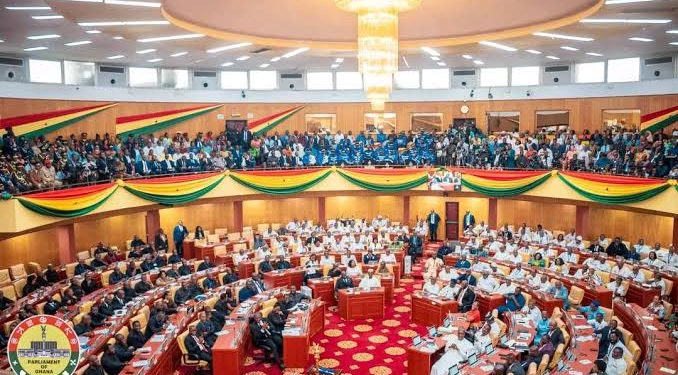
Parliament has approved a US$300 million International Development Association (IDA) credit facility to finance the Secondary Education Transformation for Access, Relevance and Results for Jobs (STARR-J) Project, a major initiative aimed at improving secondary education across Ghana.
The project seeks to expand access to quality secondary education, improve teaching and learning outcomes, strengthen technical and vocational education and training (TVET), enhance education sector governance, and eliminate the double-track system introduced under the Free Senior High School policy.
According to a report by Parliament’s Joint Committee, US$257.7 million, representing approximately 86 per cent of the facility, will be invested in infrastructure development to address the country’s secondary school infrastructure deficit.
The infrastructure programme will fund the construction of 10 new secondary schools in underserved districts, rehabilitate 150 existing schools, upgrade 30 Category C schools to Category B and 20 Category B schools to Category A, while also completing abandoned E-Block projects.
The project will further support the expansion of existing schools, provide furniture and essential educational facilities, and improve the Computerised School Selection and Placement System (CSSPS) to facilitate the transition to a single-track academic calendar.
The committee indicated that the new schools will be located in selected districts across the Central, Western North, Greater Accra, Volta, Oti, Northern, Upper East, Upper West, Savannah and Western regions.
The remaining US$33.8 million from the IDA credit facility, together with US$31 million in counterpart funding from the Government of Ghana, will be directed towards improving the quality and relevance of secondary education.
The funding will support teacher professional development, curriculum reforms, digital skills training, entrepreneurship education, stronger partnerships with industry and expanded work-based learning opportunities.
According to the committee, these interventions are intended to ensure that graduates acquire the knowledge and practical skills needed to meet the demands of the modern labour market.
Government counterpart funding will also be used to strengthen the continuous professional development of teachers and instructors, particularly to support the implementation of the revised curriculum and improve learning outcomes in mathematics, science, digital education and technical subjects.
In addition, the STARR-J Project includes measures to strengthen education management systems, improve monitoring and evaluation, enhance stakeholder communication, promote the prevention of gender-based violence and establish a contingency emergency response mechanism for future crises.
The committee noted that the initiative is designed to address longstanding challenges affecting the Free SHS programme, including inadequate infrastructure, overcrowded classrooms, limited laboratory and workshop facilities, weak ICT infrastructure, shortages of teaching and learning materials, and the mismatch between secondary education and labour market requirements.
Recommending approval of the financing agreement, the committee said the concessional IDA facility would provide Ghana with the resources needed to modernise and transform its secondary education system.
It concluded that the investment would significantly improve educational infrastructure, strengthen teaching and learning, expand technical and vocational education, improve governance within the sector and support the government’s objective of ending the double-track system.
Source: citinews
