



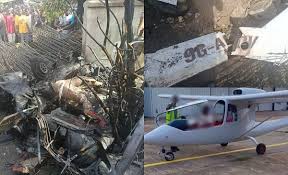
The Aircraft Accident and Incident Investigation and Prevention Bureau has concluded that engine failure caused by overheating was the primary cause of the light aircraft crash that occurred in Tema in March 2026.
Presenting the findings on Wednesday, May 27, lead investigator Captain Paul Forjoe (rtd) disclosed that the pilot’s use of his mobile phone during the flight, together with restricted access to important flight controls and instruments due to his seating position, contributed to the accident.
According to the Bureau, the aircraft most likely suffered engine failure after overheating issues were not properly addressed.
Investigators also raised concerns over the pilot’s handling of earlier signs of engine malfunction and overheating. The report stated that required maintenance checks were not carried out despite previous indications of technical problems.
The Bureau further revealed that the pilot violated aviation regulations by allowing his brother to board the aircraft during the flight. This breached one of the permit conditions, which prohibited carrying passengers or cargo not directly related to the operation of the flight.
The microlight aircraft, registered as 9G-ADV, crashed on March 16, 2026, within the premises of the TMA Day Care Centre near the Oninku Drive Basic School in Tema Community One.
Findings from the investigation showed that during all three flights from Ho Airport on the day of the accident, the pilot occupied the rear seat while his friend and brother sat in the front pilot seat. Investigators said this arrangement limited the pilot’s access to critical instruments, warning lights, and switches.
The report also indicated that the flights from Ho Airport were unauthorized because the aircraft lacked the required flying permit. In addition, both Accra and Ho airport management, as well as Air Traffic Control, were reportedly unaware of the exact conditions attached to the aircraft’s permit.
Investigators noted that the aircraft had no designated maintenance facility or personnel responsible for servicing it. They also found no maintenance records between January 14, 2026, and the date of the final flight, during which the aircraft reportedly completed 15 flights.
According to the report, the aircraft did not issue any distress signal or declare an emergency before crashing. The Bureau also stated that Air Traffic Control failed to notify AIB Ghana about the accident, contrary to aviation regulations.
The investigation concluded that the aircraft was flying too low when the engine failed, leaving the pilot with insufficient time and space to make a safe emergency landing.
Among the contributory factors identified were the pilot’s failure to address earlier engine problems, his restricted access to cockpit controls due to his seating position, and distractions caused by continuous communication on his mobile phone during the flight.
Source: 3news
