



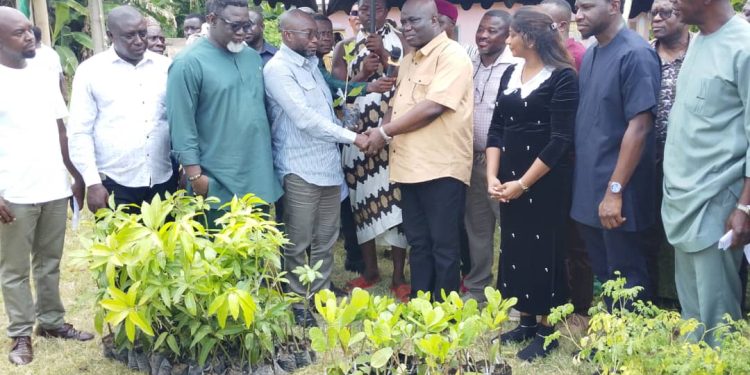
Minister for Food and Agriculture, Eric Opoku, has presented more than 1.26 million economic tree seedlings for distribution to farmers in the Bono, Bono East and Savannah regions under a national agroforestry initiative.
The seedlings, made up of moringa, cashew and mango varieties, are expected to be shared among the three regions, with Bono Region receiving 511,823 seedlings, Bono East 352,135 and Savannah Region 396,524.
Speaking during a ceremony at Nkoranza in the Bono East Region, Mr. Opoku urged farmers to actively participate in the programme by planting and nurturing the seedlings to help improve livelihoods and strengthen climate resilience.
He explained that agroforestry has become an important strategy for sustainable agricultural transformation, noting that integrating economic trees into farming systems can improve soil fertility, increase productivity and enhance long-term food security.
According to the Minister, the distribution exercise forms part of Phase II of the Changing Lives Transformation Fund Agroforestry Carbon Credit Programme being implemented across Ghana’s middle belt and Savannah regions.
The initiative aims to restore degraded lands, reduce soil erosion, conserve biodiversity and create additional income opportunities for farmers.
Mr. Opoku stressed that the programme should be viewed as a long-term investment in farmers, nutrition, climate resilience and local economic development rather than simply a donation exercise.
He further assured farmers that government, through the Ministry of Food and Agriculture, remains committed to providing extension services, technical support, training and market access to support agricultural productivity.
The Minister noted that under the Feed Ghana Programme and the Agriculture for Economic Transformation Agenda, government is working to make agriculture more profitable, resilient and attractive, especially for women and young people.
He also warned that climate change continues to negatively affect rainfall patterns, crop yields, soil fertility and rural livelihoods, making urgent interventions necessary.
Meanwhile, Deputy Country Director of the World Food Programme, Anitha Narahari, disclosed that over 7,000 additional farmers are expected to benefit from the programme.
She added that more than three million mango, cashew and moringa seedlings will eventually be distributed across targeted regions under the initiative.
According to her, the intervention is particularly aimed at supporting maize farmers vulnerable to climate shocks, erratic rainfall and declining soil fertility while helping households diversify incomes and improve resilience.
Madam Narahari reaffirmed the World Food Programme’s commitment to supporting innovative agricultural initiatives that strengthen food systems and improve long-term sustainability for vulnerable farming communities.
Source: citinews
