



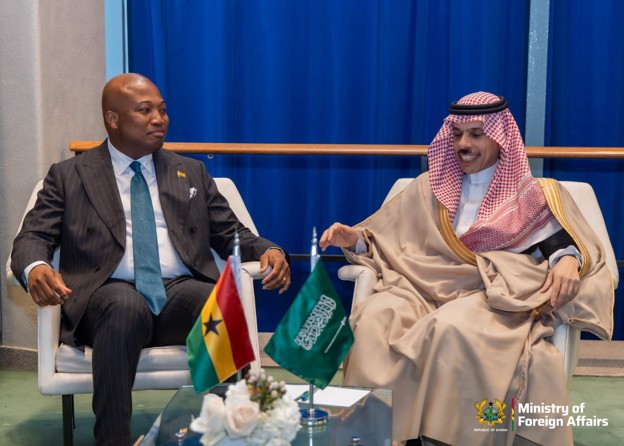
Ghana and Saudi Arabia have initiated a high-impact strategic partnership following bilateral talks between Foreign Ministers Hon. Samuel Okudzeto Ablakwa and H.E. Prince Faisal bin Farhan Al Saud at the UN General Assembly in New York. The alliance focuses on channeling Saudi investment into Ghana’s critical infrastructure, targeting railway network modernization and energy grid expansion to drive President John Dramani Mahama’s “Reset Agenda.” Furthermore, with Ghana set to assume the African Union Chairmanship, both nations are aligning foreign policy objectives to deepen Afro-Arab economic ties, enhance trade corridors under AfCFTA, and formalize long-term bilateral development pacts.
Contextualizing the New York Bilateral Engagement
During the UN General Assembly in New York, bilateral sideline engagements served as vital conduits for actionable bilateral agreements. Ghana’s diplomatic push came at a pivotal moment, with the country pursuing strategic economic recalibration alongside structural modernization.
The high-level exchange between Foreign Minister Samuel Okudzeto Ablakwa and Prince Faisal bin Farhan Al Saud marked a transition from general diplomatic goodwill to targeted investment deals. Driven by its Vision 2030 framework, Saudi Arabia continues to seek expanded economic partnerships across fast-growing African markets. In this context, Ghana offers a stable, institutionally sound doorway for Gulf capital to enter West Africa while directly backing President Mahama’s transformative Reset Agenda.
Infrastructure Modernization: The Railway Development Priority
Attracting foreign investment for Ghana’s rail network served as a primary objective during the talks. Although Ghana’s agricultural and industrial performance depends heavily on efficient freight logistics, its existing railway infrastructure requires comprehensive structural updates to support long-term economic growth.
Heavy Freight Corridors
Saudi financial institutions, including the Saudi Fund for Development, alongside private sector enterprise partners, are actively evaluating major railway infrastructure projects across Ghana. The central operational focus centers on constructing and upgrading high-capacity rail routes that link resource-rich agricultural hinterlands and key mining hubs directly to commercial deep-water ports at Tema and Takoradi. Modernizing these heavy freight supply chains drastically lowers bulk transport costs, optimizes export logistics for minerals and cash crops, and unlocks long-term industrial output across the nation.
Regional Connectivity
Integrating Ghana’s domestic rail network into broader West African transport corridors directly aligns with the objectives of the African Continental Free Trade Area (AfCFTA). Establishing continuous, cross-border freight and passenger transit networks enhances overall commercial viability by opening seamless access to regional landlocked markets. For Saudi Arabia and foreign institutional investors, this expanded trade footprint creates high-yield, long-term infrastructure investment opportunities while simultaneously establishing Ghana as the primary economic gateway and maritime transport hub for the wider West African sub-region.
Energy Infrastructure and the “Reset Agenda”
Energy resilience is the backbone of President John Dramani Mahama’s “Reset Agenda,” which seeks to reconstruct Ghana’s macroeconomic foundation, reduce the cost of doing business, and stimulate industrial production.
| Focus Sector | Strategic Objective | Saudi-Ghana Synergies |
| Grid Modernization | Stabilize industrial power delivery and reduce transmission losses. | Saudi technical expertise in power grid management and capital equipment financing. |
| Renewable Energy Transition | Increase solar and non-fossil energy output in northern generation zones. | Investment partnerships via Saudi clean-energy developers (e.g., ACWA Power model). |
| Downstream & Upstream Energy | Enhance refining capabilities and energy infrastructure logistics. | Strategic joint ventures for energy storage, processing, and distribution networks. |
Diplomatic Alignment and Ghana’s Incoming AU Chairmanship
The bilateral exchange extended beyond national projects into continental governance. As Ghana prepares to assume the Chairmanship of the African Union, Accra’s foreign policy footprint gains enhanced weight across the 55-member bloc.
The strategic synergy between Ghana and Saudi Arabia across key focus areas under President Mahama’s Reset Agenda. In grid modernization, Ghana aims to stabilize industrial power delivery and decrease transmission losses by leveraging Saudi capital equipment financing and power grid expertise. For renewable energy transition, the goal is boosting solar and non-fossil generation in northern regions through Saudi clean-energy investment partnerships like ACWA Power. Finally, in downstream and upstream energy, the strategy focuses on strengthening refining, storage, processing, and distribution logistics through targeted joint ventures.
By establishing early diplomatic consensus on continental priority issues such as climate adaptation financing, trade corridor security, and regional stability both nations ensure that bilateral investments support wider Afro-Arab trade dynamics.
Next Steps: Accelerating High-Level Engagements
The public commitment made by Minister Okudzeto Ablakwa explicitly highlighted that both governments will accelerate high-level engagements. Expected near-term outcomes include:
Reciprocal State and Ministerial Visits
To move beyond preliminary diplomatic agreements, both nations are scheduling targeted, high-level delegation visits between Accra and Riyadh. Senior leadership from the Saudi Ministry of Investment, alongside major infrastructure developers and energy enterprise executives, will travel to Ghana for comprehensive site inspections and technical due diligence. Concurrently, Ghanaian ministerial delegations will present bankable project dossiers directly to Saudi sovereign wealth representatives and private investors. These direct exchanges serve to bridge regional regulatory gaps, align project specifications with Saudi capital requirements, and build the institutional confidence required to transition strategic policy discussions into binding commercial ventures.
Joint Economic Commissions
Establishing formal Joint Economic Commissions provides the operational framework needed to oversee, track, and institutionalize multi-sector agreements between Ghana and Saudi Arabia. By creating dedicated inter-ministerial working groups focused specifically on transport corridors, energy transition projects, and bilateral trade facilitation, both governments ensure continuous project momentum. These commissions establish clear governance structures, resolve administrative bottlenecks, set definitive timelines, and evaluate key performance indicators across all proposed ventures. Ultimately, this structured institutional oversight prevents diplomatic commitments from stalling, transforming high-level international policy frameworks into structured, executable pipelines for national infrastructure development and strategic capital deployment.
Pact Formalization
The final critical phase centers on translating preliminary diplomatic understandings into legally binding commercial agreements, Concession Agreements, and Sovereign Guarantees. Legal teams and financial advisors from both governments will structure clear financial models, risk-sharing arrangements, and tax frameworks for major energy and rail projects. Securing definitive investment contracts enables the Saudi Fund for Development and private partners to commit long-term capital with minimized political and operational risk. Formalizing these legal contracts ensures financial transparency, guarantees project continuity across political administrations, and provides the regulatory foundation required to officially break ground on key national infrastructure projects.
Catalyzing the Afro-Arab Axis: How the Ghana-Saudi Alliance Redefines Gulf-Africa Dynamics
The strategic engagement between Ghana and Saudi Arabia signals a significant evolution in West Africa–Gulf Cooperation Council (GCC) dynamics. Here are four key ways this partnership elevates Ghana-Gulf relations within the broader African continent:
Positioning Ghana as the Primary Gulf Investment Gateway to West Africa
Ghana’s reputation for institutional stability and predictable regulatory environments makes it a natural hub for Gulf capital deployment across the sub-region. By directing Saudi sovereign and private capital such as the Saudi Fund for Development into foundational heavy freight rail and energy grid expansion, the partnership establishes a template for Gulf-backed infrastructure projects. Success in Ghana offers Saudi Arabia and neighboring GCC states a low-risk, high-return entry points to scale infrastructure investments into larger, interconnected West African markets.
Amplifying Afro-Arab Economic Integration Through AfCFTA Corridors
Aligning Saudi infrastructure funding with Ghana’s rail expansion directly feeds into the goals of the African Continental Free Trade Area (AfCFTA), which is headquartered in Accra. Modernizing trade routes linking Ghana’s agricultural and mining hinterlands to deep-water ports creates seamless transport channels to landlocked Sahelian nations. For the Gulf states, this transforms bilateral investments into continental trade assets, giving Saudi Arabia strategic economic depth across the West African economic bloc.
Strengthening Geopolitical Dialogue Ahead of Ghana’s AU Chairmanship
Ghana’s political trajectory toward assuming the Chairmanship of the African Union elevates these bilateral talks into a multilateral platform. Aligning diplomatic positions on security, climate resilience, and economic sovereignty allows Saudi Arabia to engage a leading voice on the African continent. Concurrently, Ghana leverages this proximity to Gulf leadership to advocate for broader African priority issues, establishing a balanced Afro-Arab diplomatic bridge that extends well beyond standard bilateral ties.
Accelerating the Transition from Philanthropic Aid to Capital Co-Investment
Historically, Gulf engagements in parts of sub-Saharan Africa leaned heavily on diplomatic development aid and grant-based support. This high-level dialogue signals a definitive shift toward commercial co-investment, strategic joint ventures, and infrastructure development. By embedding Saudi clean-energy transition partners and private infrastructure developers into President Mahama’s Reset Agenda, Ghana sets a precedent for how African nations can negotiate value-addition, job creation, and industrial processing directly into Gulf investment models.
In Conclusion: Sustaining Strategic Momentum
The bilateral agreement reached in New York marks a pivotal turning point in West Africa-Gulf relations, elevating Ghana into a primary conduit for Saudi investment across West Africa. By aligning Saudi capital with President Mahama’s Reset Agenda, the partnership addresses urgent infrastructure needs in railway development and green energy transition. Furthermore, Ghana’s impending African Union Chairmanship bridges national economic priorities with continental leadership, transforming bilateral cooperation into broader Afro-Arab integration. Moving forward, maintaining political momentum, establishing robust joint economic frameworks, and formalizing binding legal agreements will be vital to realizing these transformative cross-regional economic and diplomatic goals.