



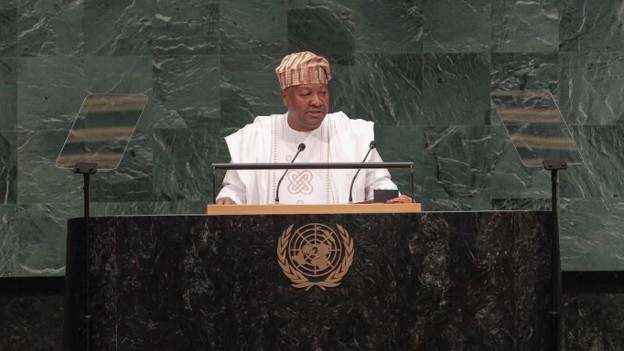
At the 81st Session of the United Nations General Assembly (UNGA 81) held in New York under the overarching theme “Restoring Trust, Managing Transformation: A United Nations that Delivers for All,” Ghana’s delegation led by President John Dramani Mahama delivered a bold, action-oriented message centered on international equity, historic accountability, and global economic reform.
Representing both national interests and wider African solidarity, Ghana used the UN floor to detail what it has accomplished, what it demands from the global order, and its concrete initiatives moving forward.
Reparatory Justice and Historical Accountability
A core pillar of Ghana’s address focused on advancing the movement for reparatory justice for the Transatlantic Slave Trade. Building upon landmark resolutions championed at the UN that formally recognize chattel enslavement as a supreme crime against humanity, Ghana pushed the international community to transition from symbolic regret to operational restitution.
What Was Said: Ghana argued that global inequality today cannot be divorced from centuries of systemic exploitation. Representatives emphasized that words and apologies are insufficient without structural mechanisms for healing, debt relief, and restitution.
What Ghana Is Doing & Intends to Do: Ghana hosted a dedicated UNGA side event titled “From Commitments to Action on Reparatory Justice: Advancing International Cooperation for the Return and Restitution of Cultural Properties and Heritage.” The government is actively leading diplomatic efforts across the African Union (AU) and Caribbean community (CARICOM) to establish formal frameworks for the return of looted African artifacts and structured financial reparations.
Reforming the Global Financial and Development Architecture
Ghana issued a critique of current global financial structures, arguing that developing nations are consistently disadvantaged by high borrowing costs, unequal access to capital, and debt traps.
What Was Said: Ghana called for a fundamental reset of how multilateral development banks operate, stressing those international institutions must move past outdated post-WWII models that entrench inequality.
What Ghana Is Doing & Intends to Do: Through its signature “Accra Reset” initiative convened at UNGA 81 under the title “Full Circle: Making Global Development Work Again” Ghana is pushing for tailored financing models, equitable climate adaptation funds, and debt-restructuring mechanisms that allow emerging economies to invest in local infrastructure without sacrificing fiscal stability.
Economic Transformation and Global Partnerships
Beyond multilateral policy, the delegation detailed Ghana’s domestic strategies aimed at transforming the country into an industrial and commercial hub for West Africa.
What Was Said: Ghanaian representatives highlighted the nation’s strategic position as the host of the African Continental Free Trade Area (AfCFTA) Secretariat, emphasizing that Africa’s economic future relies on value-addition, domestic manufacturing, and intra-African trade rather than raw material export.
What Ghana Is Doing & Intends to Do: To back these statements, the delegation engaged directly with the global private sector. Key actions included participation in the US-Ghana Presidential Roundtable, engagements with the US-Africa Chamber of Commerce, and ringing the NASDAQ Closing Bell in New York to signal Ghana’s readiness for high-value technology and sustainable energy investments.
Key Takeaways from Ghana’s UNGA 2026 Agenda
| Priority Area | Core Declaration | Strategic Action Plan |
| Reparations & Heritage | Slavery and exploitation must be answered with systemic restitution. | Leading AU-CARICOM coalitions to demand the restitution of stolen cultural property and formal reparative financial frameworks. |
| Global Finance | Current financial architectures burden developing nations with unsustainable debt. | Driving the “Accra Reset” framework to reform international development funding and climate financing. |
| Economic Growth | African growth requires trade, technology transfer, and local value-creation. | Leveraging AfCFTA and partnering with multinational investors to expand manufacturing, technology, and trade hubs in Ghana. |
Ghana’s performance at the 81st General Assembly established a dual focus: holding the global North accountable for historical and structural imbalances, while taking proactive measures to position Ghana as a resilient, self-sustaining economic partner on the world stage.
Analysis of Ghana’s ‘Accra Reset’ Framework at UNGA 81
Presented by President John Dramani Mahama during high-level side events and embedded within Ghana’s official address at the 81st United Nations General Assembly (UNGA 81) in New York, the Accra Reset is a strategic development doctrine. The framework seeks to transition countries in the Global South away from perpetual reliance on volatile external aid toward practical sovereignty, domestic resource execution, and self-directed economic transformation.
Core Objectives of the Framework
The Accra Reset was designed as a direct counter-framework to traditional donor-recipient paradigms. Its primary goals focus on three key structural challenges:
Overcoming Donor Dependence: External aid, particularly in sectors like global health and social infrastructure, has dropped dramatically in recent years (African health aid alone declined by nearly 70% between 2021 and 2025). The Reset aims to prevent national budgets from collapsing when foreign aid fluctuates.
Asserting Practical Sovereignty: Rather than merely endorsing externally designed programs, developing countries are urged to own their decision-making processes, multi-year financing frameworks, and data platforms.
Institutional Accountability: The initiative shifts focus from donor self-reporting to public Action Ledgers and objective tracking systems to hold both domestic governments and international partners accountable.
Key Pillars & Recommendations
At UNGA 81, Ghana launched the High-Level Panel report titled “A Sovereign Future for Health,” setting out the political and operational roadmap for the Accra Reset. The framework hinges on two main tracks:
Domestic Structural Shifts (“Five Political Shifts”)
Practical Sovereignty
Ministries of Health, Finance, and Planning must co-lead single-country compacts, directly mapping resource needs to break away from fragmented donor funding. By taking command of budget allocation and strategy, governments align external financial flows with national health priorities, ensuring strategic alignment, operational control, and long-term financial independence.
Sovereign Partnerships
Foreign development funding must transition away from basic healthcare delivery toward building long-term domestic capacity, regional public goods, and emergency response infrastructure. Primary operational expenses shift directly to national budgets, ending volatile aid dependencies and establishing sustainable, equitable partnerships built on equal co-investment and true local ownership.
Regional Manufacturing & Industrialization
African nations must establish localized industrial ecosystems and resilient supply chains to manufacture essential vaccines, therapeutics, and medical commodities. By utilizing trade frameworks like the AfCFTA, countries reduce reliance on external imports, secure health supply chain autonomy, retain economic value, and safeguard public health during global crises.
Functions Before Institutions
Governments and international development partners must prioritize tangible service delivery and measurable health outcomes over preserving bureaucratic institutions. Restructuring aid models around real-world impact ensures capital flows directly into active healthcare networks, frontline workforce training, essential medicines, and critical infrastructure rather than redundant administrative overhead.
Independent Accountability
Oversight mechanisms must replace donor self-reporting with public, independent Action Ledgers and tracking frameworks. Transparent monitoring holds both domestic governments and international development partners accountable to strict performance metrics, guaranteeing that commitments translate into concrete investments, measurable program delivery, and verified improvements in public health outcomes.
Reform of Global Health & Aid Agencies (“The 4 Cs”)
For multinational bodies and global development agencies, the Accra Reset proposes a streamlined mandate: Commit, Collaborate, Consolidate, and Close. International institutions whose main role is passing funds or commodities are urged to consolidate operations or strategically sunset once local capacity is established.
Global Alliances and Leadership
The Accra Reset is anchored by a presidential council and backed by cross-regional diplomatic figures. During the UNGA 81 launch, key endorsements and participation came from:
African & Global Leaders: Kenyan President William Ruto, Barbadian Prime Minister Mia Mottley, former British Prime Minister Gordon Brown, and former African heads of state including Olusegun Obasanjo (Nigeria) and Ellen Johnson Sirleaf (Liberia).
International Bodies: Representatives from the World Health Organization (WHO), the Group of 77 (G77), the Commonwealth, Gavi (the Vaccine Alliance), and the Global Fund.
Summary of Framework Design
| Feature | Old Development Model | The Accra Reset Framework |
| Primary Funding | Volatile foreign grants and donor-driven loans | Domestic taxation and structured sovereign wealth investments |
| Governance | Externally designed NGO/aid programs | One-stop national compacts run by local ministries |
| Manufacturing | Raw material export and finished-product imports | Local production, value-addition, and regional supply hubs |
| Accountability | Donor self-reporting and compliance audits | Public Action Ledgers and independent tracking |
Examine how the Accra Reset framework aligns with the objectives of the African Continental Free Trade Area (AfCFTA).
The Accra Reset framework launched at the 81st United Nations General Assembly (UNGA 81) by President John Dramani Mahama functions as the political and operational engine that powers the objectives of the African Continental Free Trade Area (AfCFTA).
While AfCFTA provides the legal framework and tariff reductions for a single African market, the Accra Reset supplies the industrial, financial, and executive strategy necessary to make cross-border trade a commercial reality rather than a theoretical policy agreement.
Bridging Policy and Industrial Execution
AfCFTA aims to eliminate tariffs on 90% of goods traded across Africa. However, tariff removal alone cannot stimulate intra-African trade if member states do not produce high-value goods locally.
AfCFTA Objective: Boost intra-African trade through regional value chains and diversified production.
The Accra Reset Alignment: The Reset establishes a strategy focused on modular industrialization in key growth sectors such as pharmaceuticals, textiles, agribusiness, and agroforestry. By promoting local value-addition instead of raw material exportation, the Reset ensures that African states have processed, high-grade products to trade under AfCFTA preference rules.
Health Sovereignty and Regional Pharmaceutical Hubs
A main showcase of the Accra Reset at UNGA 81 was its report on global health architecture (“A Sovereign Future for Health”), which emphasizes local pharmaceutical manufacturing.
AfCFTA Objective: Create an integrated single market for medical products and vaccines to improve continent-wide health security.
The Accra Reset Alignment: The Reset explicitly targets the shift from importing finished medical supplies to building regional manufacturing corridors. It directs capital toward African pharmaceutical hubs (in Ghana and across regions), ensuring that vaccines and essential medicine produced in one African nation can be seamlessly traded across the continent via AfCFTA mechanisms.
Financial Autonomy vs. Foreign Conditionalities
AfCFTA requires significant capital investments in cross-border transport, logistics, digital trade infrastructure, and trade finance.
AfCFTA Objective: Finance continent-wide infrastructure projects independently and facilitate cross-border payment settlements.
The Accra Reset Alignment: Through its Domestic Resource Sovereignty pillar, the Accra Reset challenges reliance on volatile foreign aid and donor loans with high interest rates. It encourages countries to pool sovereign wealth, mobilize domestic tax revenues, and establish sovereign negotiation platforms (such as the Sankoree Institute of Global Negotiators / SIGN). This ensures African nations retain the policy space needed to finance trade corridors without onerous external conditions.
Execution Accountability & Sovereign Prosperity Corridors
Trade agreements often stall during national implementation. The Accra Reset introduces concrete operational tools to maintain momentum.
AfCFTA Objective: Transition from signing protocols to active trade flows across borders.
The Accra Reset Alignment: The Reset replaces non-binding summit declarations with an Action Ledger, a public tracking system that holds governments and business coalitions accountable for specific delivery milestones. Furthermore, it establishes Sovereign Prosperity Spheres (SPS) and operational corridors, mapping specific industrial hubs directly to AfCFTA supply chains.
Strategic Synergies
| Operational Domain | AfCFTA Framework | Accra Reset Engine |
| Trade Architecture | Legal rules, tariff cuts, and trade-barrier removal. | Local manufacturing, processing capacity, and supply chain creation. |
| Health Sector | Single-market standards for medical devices and drugs. | Regional manufacturing hubs for vaccines, equipment, and pharmaceuticals. |
| Capital & Investment | Intra-African investment protocols and trade finance. | Domestic resource mobilization and sovereign negotiation platforms. |
| Governance | Council of Ministers and AfCFTA Secretariat monitoring. | Public Action Ledgers tracking execution milestones in real time. |
Because Accra serves as the host city for the AfCFTA Secretariat, Ghana’s launch of the Accra Reset at UNGA 81 reinforces the country’s dual role as both the diplomatic headquarters of African free trade and the primary architect of its practical execution strategy.
Key Insight & Points Made by Ghana on UNSC Reform
At the 81st Session of the United Nations General Assembly (UNGA 81), President John Dramani Mahama placed the reform of the United Nations Security Council (UNSC) at the very center of Ghana’s national statement.
Ghana delivered a sharp critique of the Council’s current structure, framing its reform not as a political request, but as an existential necessity for global governance.
In line with the African Union’s Ezulwini Consensus, Ghana demanded that African nations be granted permanent representation on the Council with all corresponding rights, responsibilities, and veto powers enjoyed by the P5 (China, France, Russia, UK, US).
“Security Council reform is not a favour to Africa; it is an imperative for the legitimacy, credibility, and survival of the United Nations.” – President John Dramani Mahama, UNGA 81
Summary of Ghana’s Demands for UNSC Reform
| Area | Current Status | Ghana’s Demand at UNGA 81 |
| Permanent Seats | 0 seats for Africa | Permanent seats designated for African nations. |
| Veto Rights | Held exclusively by the P5 | Equal veto rights and privileges for permanent African members. |
| Core Rationale | Based on 1945 post-WWII power balances | Based on 21st-century demographics (1.5B people) and global equality. |
| Multilateral Goal | Selective application of veto decisions | Ending impunity and restoring international confidence in the UN Charter. |