



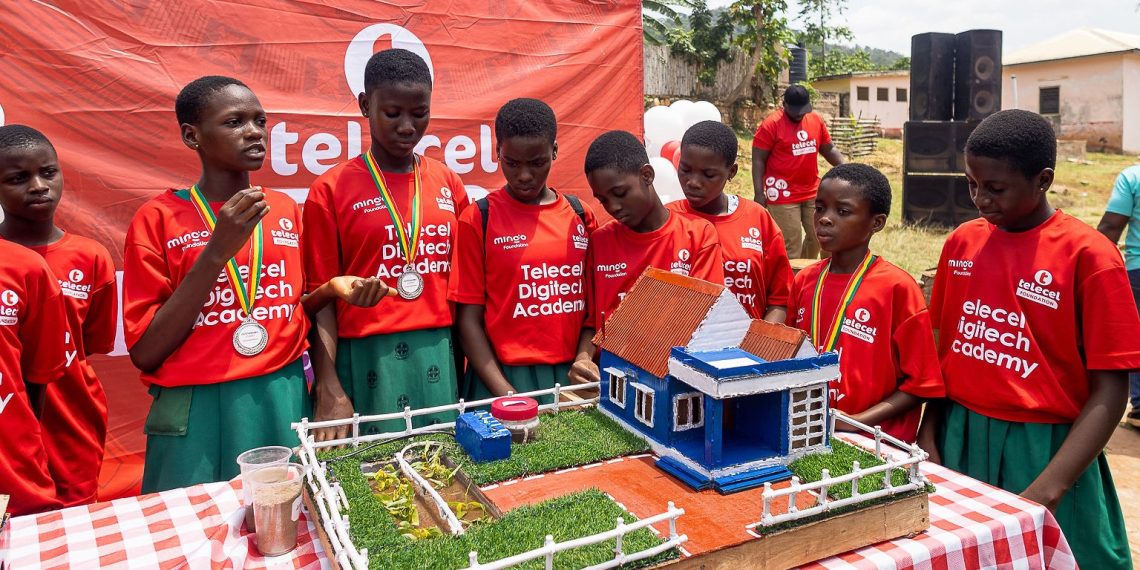
A total of 500 upper primary and junior high school students from five regions have successfully completed the third cohort of the Telecel Foundation’s DigiTech Academy, a 12-week after-school programme focused on digital skills such as robotics, coding, web design, and Internet of Things (IoT).
The main graduation ceremony took place in Peki Blengo in the Volta Region, where students from Peki Blengo Evangelical Presby JHS and Peki Adzokoe Roman Catholic School ներկայաց their final projects. These included practical, community-focused innovations such as an automated irrigation system, smart night light, distance monitoring system, and a security alarm system.
The programme, delivered in partnership with the Ghana Education Service, the National STEM Centre, Mingo Foundation, and Asustem Robotics, held simultaneous graduation events across five regions. Participants came from 19 schools in districts including South Dayi (Volta), Mfantsiman (Central), Jirapa (Upper West), Goaso (Ahafo), and Bolgatanga (Upper East).
Students received hands-on training in Scratch programming, Arduino-based robotics, and website design. Educators say the impact has been significant. Vincent Adzagbenu, Headteacher of Peki Blengo EP JHS, noted that students are now more confident, creative, and able to apply their knowledge to solve real-life problems.
Telecel Ghana’s Director of External Affairs, Komla Buami, emphasized that the initiative demonstrates how young people can excel when given access to practical digital tools and opportunities. He added that training teachers is also key to sustaining the programme’s impact.
Rev. Gideon Korsi Asiam of the South Dayi Education Directorate praised the initiative for complementing classroom learning by promoting critical thinking, teamwork, and problem-solving skills.
Across other regions, students showcased equally impressive projects. In Goaso, innovations included a parcel delivery robot, smart cocoa drying system, and pesticide sprinkler robot. Bolgatanga students developed solutions such as an RFID drink dispenser, a speed detector with SMS alerts, and a forest fire detector. Projects from Kormantse and Jirapa ranged from smart traffic systems to robotics and mobile applications.
Since its launch in Ho in 2024, the DigiTech Academy has trained over 2,300 students across 13 regions, achieving a 96% graduation rate. Notably, 70% of participants have been female, highlighting a strong commitment to promoting girls’ participation in STEM.
Rita Agyeiwaa Rockson, Head of Foundation, Sustainability and External Communications at Telecel Ghana, reaffirmed plans to expand the programme nationwide, with future cohorts expected to include training in artificial intelligence alongside robotics and web design.
She stated that the goal is to equip more young Ghanaians with the digital skills needed to drive innovation and shape the country’s technological future.
Source: citinews
