



For much of the past two decades, Qatar’s economic story has been inseparable from natural gas. The country built extraordinary global influence around liquefied natural gas (LNG), using hydrocarbon revenues to finance infrastructure, education, logistics, sports, diplomacy and sovereign investment. That model remains powerful.
Qatar was the world’s second-largest LNG exporter in 2024 and accounted for nearly one-fifth of global LNG exports, according to the US Energy Information Administration. QatarEnergy is simultaneously pursuing further North Field expansion that is expected to lift Qatar’s LNG production capacity to 142 million tonnes per annum by the end of 2030.
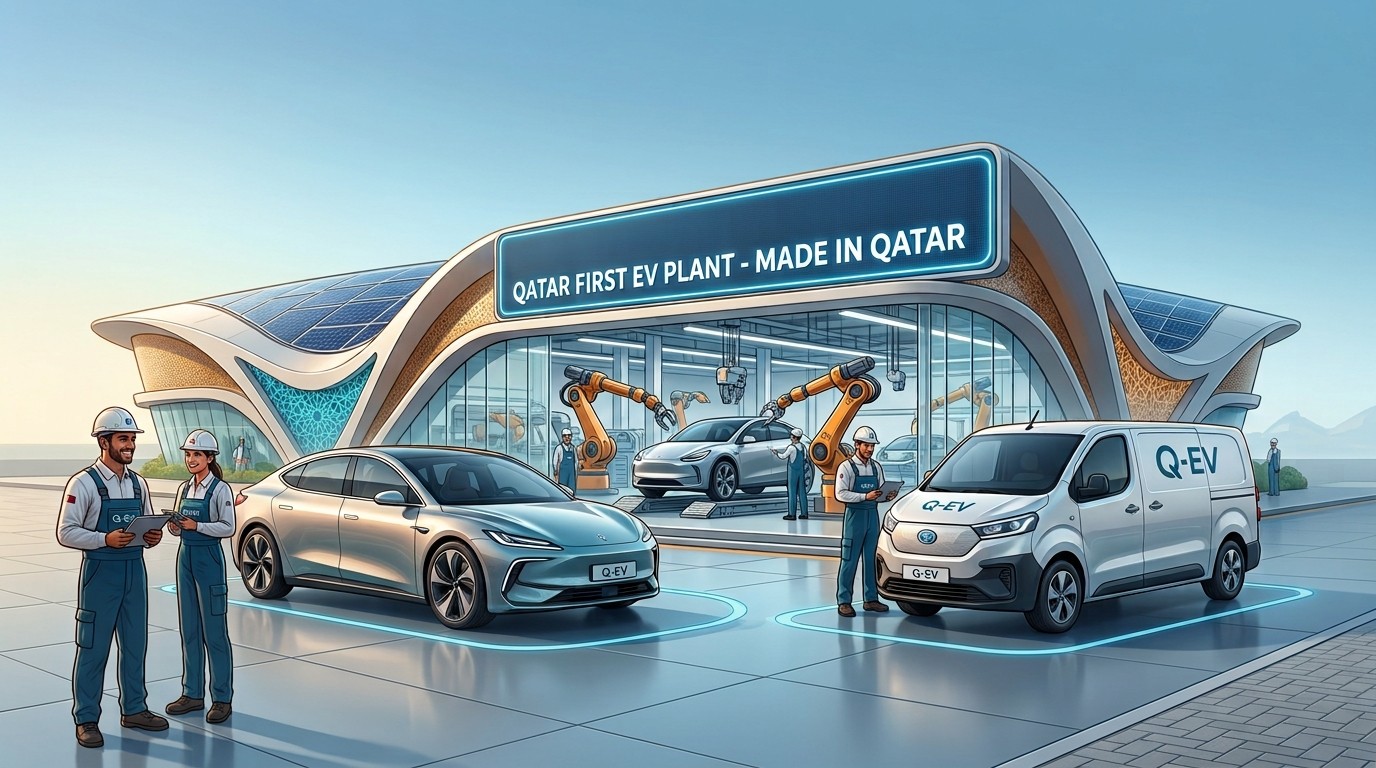
Yet the next phase of Qatar’s development is increasingly about what it can manufacture, design and export beyond hydrocarbons. The announcement that Qatar-based JTA International Investment Holding and Britain’s Watt Electric Vehicle Company will establish Qatar’s first dedicated EV manufacturing plant is therefore more significant than the number of cars the factory may initially produce.
The project is expected to begin production in 2028, with an initial output reported at about 5,000 vehicles a year. The partners plan to engineer passenger cars and medium-sized delivery vans in the United Kingdom and manufacture them in Qatar, using Watt EV’s patented PACES platform. The vehicles are intended specifically for Gulf operating conditions, including extreme heat and demanding regional usage patterns.
The immediate industrial footprint may be modest. The strategic message is not. The project represents a move from exporting energy to manufacturing technology-enabled products, developing industrial skills, transferring technology and creating a potential regional export platform.
Qatar’s diversification test
Qatar National Vision 2030 is built around four interconnected pillars: human development, social development, economic development and environmental development. The economic pillar explicitly calls for a competitive and diversified economy, while the environmental pillar seeks a balance between economic and social development and environmental protection.
This makes the EV plant a natural fit for the Vision. It connects several objectives at once: advanced manufacturing, private-sector participation, technology transfer, skilled employment, innovation, cleaner mobility and export diversification.
The distinction between Qatar’s LNG economy and its emerging EV economy is important. LNG monetizes a natural resource. EV manufacturing monetizes a combination of capital, engineering knowledge, industrial organisation, intellectual property, supply chains and market access. That does not mean Qatar is abandoning LNG. Quite the opposite. QatarEnergy continues to invest heavily in LNG. The more accurate interpretation is that Qatar is using the strength of its hydrocarbon economy to finance a broader portfolio of future industries.
Qatar’s own leadership has repeatedly identified economic diversification, private-sector development, research and development, technology and new industries as important elements of the post-hydrocarbon development phase. The EV project therefore fits a wider strategic transition: using resource wealth to build capabilities that remain valuable as the global economy changes.
Why an EV plant, and why now?
The global automotive industry is undergoing a structural transformation. According to the International Energy Agency’s Global EV Outlook 2026, electric-car sales exceeded 20 million in 2025, representing one-quarter of all new cars sold globally. The IEA estimates that the global electric vehicle stock displaced approximately 1.2 million barrels of oil per day in 2025.
The transition is also changing where industrial value is created. Nearly 22 million electric cars were produced worldwide in 2025. China accounted for almost 75% of global EV production and around 40% of global EV trade, reinforcing its position as the dominant manufacturing center.
Qatar is unlikely to compete with China on volume. It does not need to. A more rational strategy is to compete through specialised vehicles, engineering, regional adaptation, premium commercial applications, technology partnerships and access to Gulf markets.
The planned Qatar-WATT partnership illustrates this approach. Rather than simply importing finished vehicles, Qatar will participate in the development and manufacture of vehicles designed around the climate and operating environment of the Gulf. This creates opportunities for local capabilities in vehicle engineering, assembly, testing, software, battery management, thermal management, maintenance and after-sales services.
Qatar’s EV ambitions also predate the new factory announcement. Invest Qatar has identified electric vehicles as an advanced manufacturing opportunity and previously highlighted targets including 100% electric public transport by 2030, approximately 15,000 public charging stations by 2030 and EVs accounting for 10% of vehicle sales by 2030.
Qatar has already gained experience in electric public transport. The Lusail electric-bus depot was designed for 478 buses and became one of the region’s most prominent examples of large-scale electric public transport infrastructure.
The new factory therefore represents another layer of the strategy: moving from deploying EV technology to developing a domestic manufacturing capability.
From assembly to industrial capability
Qatar’s EV ambition extends beyond simply assembling vehicles. The JTA-WATT project seeks to build domestic capabilities in vehicle engineering, manufacturing, technology transfer and innovation. This distinction is important because sustainable industrialization depends on developing local skills, suppliers and technical expertise rather than relying solely on imported components. The facility could support training for engineers and technicians while encouraging investment in battery systems, software, vehicle testing and after-sales services. If successfully implemented, Qatar can evolve from an importer and user of EV technology into a regional producer and exporter, supporting its broader objective of economic diversification under Qatar National Vision 2030.
The Gulf as a test laboratory
Qatar’s EV strategy turns the Gulf’s extreme climate into an engineering advantage. The new factory will develop vehicles specifically for high temperatures, focusing on battery performance, thermal management and regional driving conditions. This is important because conventional EVs and charging systems can experience reduced performance under extreme heat. Qatar’s research institutions have already documented the effects of high temperatures on EV charging infrastructure.
By testing and refining EVs in these demanding conditions, Qatar could develop technologies suitable not only for the GCC but also for other hot-climate markets, including Africa. The project therefore positions Qatar as a potential hub for climate-adapted electric mobility and advanced automotive innovation.
What it could mean for Africa
Qatar’s emerging EV manufacturing capability could open a new channel for Gulf-Africa cooperation in clean mobility, investment and technology transfer. Africa’s EV market is still relatively small, but it grew from about 4,000 electric-car sales in 2023 to approximately 25,000 in 2025, indicating rising momentum. Qatar could potentially provide capital, manufacturing expertise, charging infrastructure and fleet-electrification solutions, while African countries offer growing markets, industrial opportunities and critical mineral resources. This could support local vehicle assembly, battery value chains, technical training and renewable-powered charging networks. Morocco’s planned 10 GWh lithium-iron-phosphate battery plant, with potential expansion to 100 GWh, demonstrates the scale of Africa’s emerging opportunity. For countries such as Ghana, the development could strengthen partnerships with Qatar around electric buses, commercial vehicles, charging infrastructure and skills development. More broadly, Qatar’s EV ambitions could contribute to a shift from traditional resource-based trade toward technology-driven Gulf-Africa industrial cooperation.
Ghana’s strategic opening
Qatar’s emerging EV manufacturing industry presents Ghana with an opportunity to deepen bilateral relations beyond traditional trade and energy cooperation. Ghana already has a National Electric Vehicle Policy targeting approximately 35% EV penetration by 2035 and an eventual phase-out of new petrol and diesel vehicle sales and imports by 2045. Qatar could therefore become a strategic partner in EV assembly, charging infrastructure, technical training, fleet electrification and technology transfer. Ghana could also leverage its position as the host of the AfCFTA Secretariat to promote Qatar-Ghana cooperation as a gateway for Gulf investment into Africa’s emerging green-mobility market.
A Ghana-Qatar EV partnership
Ghana and Qatar could build a strategic partnership around electric mobility, combining Qatar’s investment capacity and growing EV expertise with Ghana’s emerging market and regional position. Ghana’s National EV Policy targets about 35% EV penetration by 2035 and aims to end new petrol and diesel vehicle sales or imports by 2045. A Ghana-Qatar partnership could therefore focus on EV assembly, charging infrastructure, technical training, fleet electrification and renewable-energy-powered mobility. Such cooperation would complement existing Ghana-Qatar investment discussions covering manufacturing, energy, technology and infrastructure. It could also position Ghana as a West African hub for Qatar-backed clean-transport investment and technology transfer.
What Ghana can learn from Qatar
Ghana can learn from Qatar’s deliberate approach to economic diversification: using existing resource wealth and investment capacity to build new industries, technology and human capital. Qatar’s National Vision 2030 emphasizes a competitive, diversified, knowledge-based economy driven by innovation, private-sector participation and foreign investment. Ghana should similarly integrate EV policy with industrialization, skills development, renewable energy, charging infrastructure and local manufacturing. Rather than focusing primarily on importing EVs, Ghana can pursue strategic partnerships that promote assembly, technology transfer, component manufacturing and regional exports, positioning the country as a West African hub for clean mobility under AfCFTA.
The diplomatic dividend
Qatar’s EV ambitions create an opportunity to deepen its relationship with Africa through technology, investment and clean mobility. For Ghana, the opportunity is particularly strategic. Ghana and Qatar already have mechanisms for expanding cooperation in trade, investment, energy and technology, while Qatar has identified Ghana as a gateway to West African markets. Ghana could leverage this relationship to attract Qatari investment into EV assembly, charging infrastructure, technical training and renewable-energy-powered transport. Such cooperation would align with Ghana’s ambition to become a West African e-mobility hub and could connect Qatar’s capital and technology with AfCFTA’s continental market. This would transform bilateral diplomacy into tangible economic partnership and strengthen Ghana’s position as Qatar’s strategic gateway to West Africa.
From LNG diplomacy to technology diplomacy
Qatar’s emerging EV manufacturing ambitions signal a broader shift from resource-based influence toward technology-driven diplomacy. While LNG will remain central to Qatar’s economic strength, Qatar National Vision 2030 explicitly seeks a diversified, knowledge-based economy supported by innovation, private-sector development and advanced industries. The EV sector provides an opportunity to translate Qatar’s financial strength into technology, manufacturing expertise, skilled employment and international partnerships. For Africa, this could create opportunities for investment in electric mobility, charging infrastructure, skills development and vehicle assembly. Ghana, in particular, could leverage its National EV Policy and position within AfCFTA to deepen cooperation with Qatar, positioning itself as a West African hub for clean mobility and advanced manufacturing. Qatar’s transition therefore represents more than economic diversification: it could become a new instrument of international influence, linking Gulf capital and technology with Africa’s industrial and sustainable-development ambitions.
Written By: Seade Caesar, Ch.E. MIoD
