



The Bui Power Authority (BPA) generated US$145.9 million in revenue and recorded a net profit of US$66.2 million in 2025, according to its latest Corporate Annual Report.
The Authority attributed its strong financial performance to increased electricity generation, expansion of its renewable energy portfolio and progress on strategic projects aimed at enhancing Ghana’s long-term energy security.
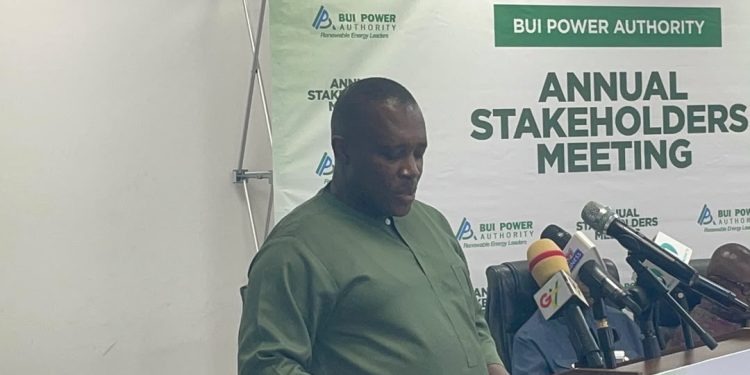
Speaking at the Authority’s annual stakeholders’ meeting, Chief Executive Officer Ing. Kow Eduakwa Sam said BPA remained operationally stable despite leadership changes within the Ministry of Energy, the Authority’s Board and Executive Management during the year.
He noted that although the energy sector experienced policy shifts, the Authority successfully adapted while maintaining its operational performance.
The report revealed that BPA expanded its installed solar photovoltaic (PV) capacity from 55 megawatt-peak (MWp) to 105MWp, increasing its overall generation capacity to 404MW of hydropower and 105MWp of solar energy.
The Authority also strengthened its financial position by improving operational efficiency and reducing outstanding receivables from key customers.
According to Ing. Sam, BPA will continue implementing measures to enhance financial sustainability while delivering long-term value.
Electricity generation also exceeded expectations in 2025. Total output reached 1,438 gigawatt-hours (GWh), surpassing the projected 1,350GWh by 6.5 per cent and exceeding the 1,348GWh generated in 2024 by 6.7 per cent.
Hydropower remained BPA’s primary source of electricity, with the Bui hydroelectric plant producing 1,339GWh, representing a 5 per cent increase over the previous year.
Solar generation also recorded significant growth following the commissioning of 50MWp under the Authority’s ongoing 100MWp solar PV project. Combined with its 5MWp floating solar facility, BPA’s total installed solar capacity reached 105MWp.
To improve the reliability of renewable energy, the Authority commissioned a 28-megawatt-hour Battery Energy Storage System (BESS) to strengthen grid stability and support greater integration of solar power into the national electricity grid.
As a result, electricity generated from BPA’s solar installations increased from 76GWh in 2024 to 102GWh in 2025.
The Authority said work is progressing on several renewable energy projects, including the remaining 50MWp phase of the 100MWp solar project, the 50MWp Yendi Solar PV Project, the 25MWp Floating Solar PV Project, and the 20MWp land-based solar project at the Bui Generating Station. All are expected to be completed in 2026.
Looking ahead, BPA plans to operationalise 145MWp of additional solar projects next year, while conducting feasibility studies for a 500MWp solar PV plant supported by a 400MWh battery energy storage system.
The Authority also intends to begin construction of a 200MW solar PV plant with a 100MWh battery storage system, with approximately 80MWp expected to become operational before the end of 2026 to help address Ghana’s projected electricity supply deficit.
On safety performance, Ing. Sam said BPA maintained a strong safety culture throughout 2025, recording zero lost-time injuries among employees and contractors.
He added that feasibility studies for proposed hydropower projects on the Tano, Pra and Ankobra rivers, as well as Wli Falls, had reached 35 per cent completion by the end of 2025.
According to the Authority, these projects are expected to further expand Ghana’s renewable energy capacity and strengthen the integration of multiple clean energy sources into the national power system.
Source: citinews
