



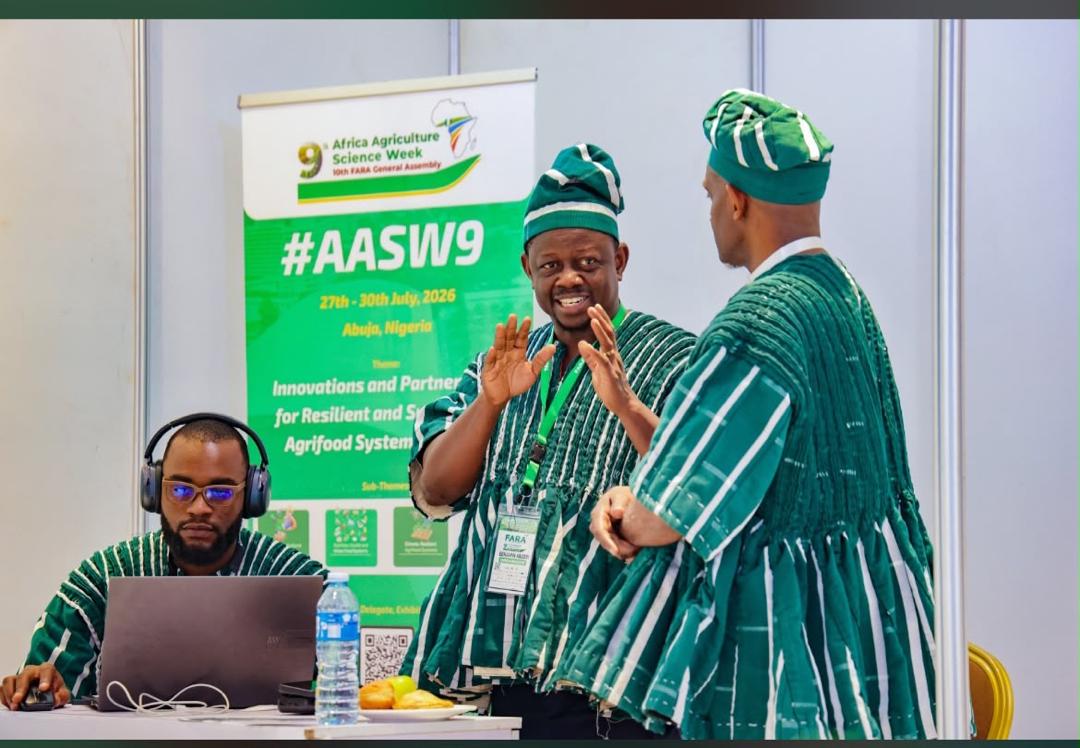
Standfirst: Four intensive days in Abuja brought together Africa’s agricultural research, policy, investment and innovation communities around a shared imperative: translating science and partnerships into resilient, inclusive and sustainable agrifood systems. For those of us who worked behind the scenes, the 9th Africa Agriculture Science Week and 10th FARA General Assembly were both a continental milestone and a powerful lesson in collective delivery.
From 27 to 30 July 2026, the Abuja Continental Hotel became a meeting point for the institutions, professionals and ideas shaping the future of African agriculture. The 9th Africa Agriculture Science Week (AASW9) and the 10th General Assembly of the Forum for Agricultural Research in Africa (FARA) convened under the theme:
“Innovations and Partnerships for Resilient and Sustainable Agrifood Systems in Africa.”
Co-organised by FARA, CORAF, the Agricultural Research Council of Nigeria and the Government of the Federal Republic of Nigeria, the event brought together ministers, African Union representatives, national agricultural research systems, CGIAR centres, universities, farmers’ organisations, development partners, private-sector actors, innovators, media practitioners and knowledge professionals. The programme combined high-level plenaries and ministerial dialogues with technical sessions, side events, exhibitions, policy and investment discussions, Nigeria Day and the statutory FARA General Assembly. (AASW Fara Africa)

The opening and high-level sessions of AASW9 brought together government leaders, researchers, development partners and agrifood-system actors from across Africa and beyond
A continental gathering of considerable scale
AASW9 recorded 924 participants, comprising 822 delegates and participants and 102 service providers. Nigeria accounted for more than half of the recorded delegates, demonstrating strong host-country mobilisation while the event retained significant regional and international participation. Research and academia represented approximately 70 per cent of participants, followed by policy actors at about 12 per cent.
Available gender data recorded 546 men and 276 women, representing approximately 66.4 per cent male and 33.6 per cent female participation. The figures demonstrate the reach of the event while also reminding us that future continental convenings must continue deliberately expanding women’s participation and leadership across scientific, policy, investment and institutional spaces.
The conference programme featured 25 side events and eight parallel or related sessions, attracting a cumulative headcount of 1,791 participants. Side events recorded 1,044 attendances, while parallel and other sessions registered 747. A further 312 people joined tracked sessions online. These figures point to a strong appetite for specialised spaces where participants could examine practical questions around innovation scaling, soil health, climate resilience, knowledge management, investment, nutrition, gender, youth, extension and research-policy linkages.
Science must move beyond outputs
One message remained consistent throughout the four days: strong scientific research is indispensable, but research outputs alone will not transform Africa’s agrifood systems.
Technologies must move through functioning systems of validation, regulation, finance, extension, market access, enterprise development and public-sector implementation. Performance must consequently be measured not only through publications and technologies released, but also through adoption, commercial uptake, productivity, resilience, incomes, nutrition and inclusion.
This message was reinforced at the opening ceremony. Representing President Bola Ahmed Tinubu, the Federal Minister of Agriculture and Food Security, Senator Abubakar Kyari, CON, called for greater African investment in agricultural research, science and innovation. He emphasised that natural resources alone cannot create prosperity unless knowledge is translated into innovation, enterprise and opportunities that improve people’s lives. Agriculture was positioned not only as a food-security concern, but also as a matter of national security, economic growth and social stability. (The Guardian Nigeria)
Innovations made visible
The exhibition was one of the most dynamic components of the week. A total of 35 exhibitors participated, including 20 national agricultural research institutes and federal colleges and 15 international and regional organisations.
The exhibition featured technologies, products and services covering crop improvement, livestock, fisheries, forestry, mechanisation, extension, agroecology, climate-smart agriculture, digital agriculture, seed systems and agricultural value chains. It created a practical interface among researchers, policymakers, students, technology developers, agribusinesses and development organisations.
The exhibition also generated important lessons. Indoor booths generally attracted strong engagement, while some outdoor exhibitors experienced lower visitor traffic. Future editions should integrate all exhibition areas more deliberately, strengthen directional signage, organise scheduled exhibition tours and clarify package benefits before exhibitors arrive.
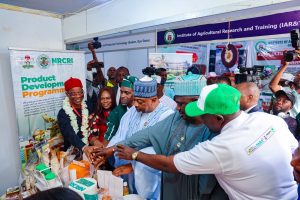
Government leaders and delegates engage with products and innovations presented by Nigerian and continental agricultural research institutions during the AASW9 exhibition.
A major personal highlight: renewing Africa’s knowledge partnership
Among the many important outcomes of AASW9, one stands out strongly for me: the signing of the renewed Knowledge Management Partnership Framework for Agricultural Research for Development in Africa, 2026–2030.
The framework brings together the African Union Commission, the AARIEI and CAADP-XP4 partners—including FARA, AFAAS, ASARECA, CORAF, CCARDESA and NAASRO—the CGIAR, led through ILRI and IITA, and the KM4AgD Community of Practice. It incorporates recommendations and actions developed through engagement with Africa’s agricultural knowledge-management community.
This renewed five-year framework builds on the foundation established through the 2023–2025 partnership. However, its direction is more ambitious. It positions knowledge management not merely as documentation, dissemination or repository management, but as a strategic system for:
- adaptive learning and implementation intelligence;
- stronger institutional coordination;
- interoperable digital knowledge infrastructure;
- responsible adoption of artificial intelligence;
- capacity sharing and institutional strengthening;
- respectful integration of indigenous and local knowledge;
- high-value knowledge products and services; and
- stronger evidence of how knowledge management contributes to agricultural transformation.
The framework recognises that innovations cannot scale effectively when knowledge remains fragmented, inaccessible or disconnected from implementation. It therefore commits the partners to annual planning, shared platforms, consultation and learning processes, joint resource mobilisation, periodic review and stronger documentation of institutional uptake and impact.
For me, the signing was especially meaningful because it represented the culmination of sustained collaboration involving colleagues across FARA, the CAADP-XP4 institutions, CGIAR, the African Union and the KM4AgD Community of Practice. The process included technical discussions, partner consultations and community validation before the framework reached the endorsement stage in Abuja. An earlier public validation process had invited policymakers, researchers, development partners, academics and knowledge practitioners to help shape the continental framework.
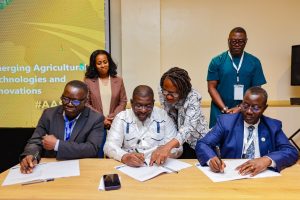
Representatives of leading African agricultural research and innovation institutions sign the renewed 2026–2030 Knowledge Management Partnership Framework for AR4D in Africa

Partners celebrate the endorsement of a five-year framework designed to strengthen adaptive learning, digital knowledge systems and institutional collaboration across African AR4D
From fragmented financing to African-led investment
Another major outcome was the Abuja Clarion Call on Sustainable Financing for Agricultural Research, Development and Innovation.
The Clarion Call urged Africa to move away from fragmented and externally dependent funding towards predictable, African-led investment in research and innovation. Its key demands include:
- increased domestic financing for agricultural research;
- stronger agricultural development funds and sustainable financing institutions;
- an African-led resource-mobilisation process;
- stronger public-private partnerships;
- expanded blended and innovative financing instruments; and
- deeper continental collaboration to implement the Kampala CAADP Declaration.
Critically, the Government of Nigeria, through the Federal Ministry of Agriculture and Food Security, committed to championing African-led resource mobilisation, including support for FARA’s proposed endowment fund. This creates an important opportunity to move from repeated concern about inadequate research financing towards a more organised continental mechanism for sustained investment.
Governance renewed through the 10th General Assembly
The 10th FARA General Assembly provided the statutory platform for constituents to review progress and guide FARA’s strategic and governance direction. It ratified the composition of the organisation’s Board of Directors for the 2026–2029 term.
The Board is chaired by Dr Mark Cyubahiro Bagabe of Rwanda and brings together representation from the FARA Secretariat, ASARECA, CCARDESA, NAASRO, CORAF, CGIAR, the African Development Bank, the African Union Commission, the private sector and farmers’ organisations. This composition reflects the institutional diversity required to connect continental policy, agricultural research, financing, enterprise and farmer perspectives.
The General Assembly’s importance extends beyond institutional procedure. It provides the governance mechanism through which FARA’s constituents can hold the organisation accountable, endorse its direction and ensure that the outcomes of AASW9 are translated into coordinated continental action. The General Assembly is FARA’s supreme governance body and is convened every three years. (AASW Fara Africa)
Visibility beyond the conference rooms
The event generated strong digital and media visibility. Across FARA’s tracked platforms, AASW9 recorded more than 332,868 impressions or reach, over 38,123 interactions and engagements, and at least 162 media and content items across social media, online news, YouTube, radio and television.
These results extended the conference beyond those physically present in Abuja. They also demonstrated that communication and knowledge-sharing are not peripheral event functions: they are central to building public understanding, sustaining partnerships and ensuring that technical outcomes reach the institutions and communities expected to act on them.
The people behind the platform
Continental events of this scale are visible through stages, speakers, banners and formal ceremonies. Their success, however, is built through months of planning, constant coordination, long meetings, shifting logistics, late-night reviews and teams solving problems that most participants will never see.
I was privileged to serve as one of the lead coordinating team members, working closely with my supervisor, Prof. Oluwole Fatunbi, our Executive Director, Dr Aggrey Agumya, and colleagues who remained in the “trenches” from planning to delivery.
My sincere appreciation goes to Dr Abdulrazak Ibrahim, Francis Kpodo, Merline Mensah, Vesta Nunoo, and the many colleagues across FARA, ARCN, CORAF, the government ministries, the KM4AgD Community, service teams, communications teams, programme teams and partner institutions whose commitment made the event possible. The names mentioned here represent only part of a much wider team whose collective effort delivered an exceptional continental gathering.

Members of the FARA Secretariat support coordination, participant engagement and real-time problem-solving throughout AASW9
A moment with the Executive Director of FARA, Dr Agumya, after four demanding but rewarding days of teamwork at AASW9
Abuja must now become a delivery agenda
The success of AASW9 should not be measured only by the number of participants, sessions, exhibitions or media impressions. Its true value will be determined by what happens next.
The immediate priorities are clear:
- package the outcomes into a consolidated communiqué, policy briefs and accessible knowledge products;
- activate the Knowledge Management Partnership Framework;
- follow through on the Abuja Clarion Call and its financing commitments;
- track the implementation of declarations, agreements and institutional pledges;
- strengthen collaboration with Nigerian institutions, CGIAR centres, sub-regional organisations, AFAAS, NADF, TETFund, NESG and other partners; and
- use the lessons from Abuja to begin planning the next AASW earlier and more systematically.
AASW9 reaffirmed that Africa’s agricultural transformation must be science-led, innovation-driven, partnership-based, knowledge-enabled and adequately financed.
For those of us who helped build the platform, the four days in Abuja were exhausting, inspiring and deeply rewarding. They reminded us that transformation is not achieved by institutions acting alone. It emerges when people, knowledge, resources and mandates are deliberately connected around a common purpose.
The conference has ended. The work of delivering its commitments has begun.
By Benjamin Abugri
