


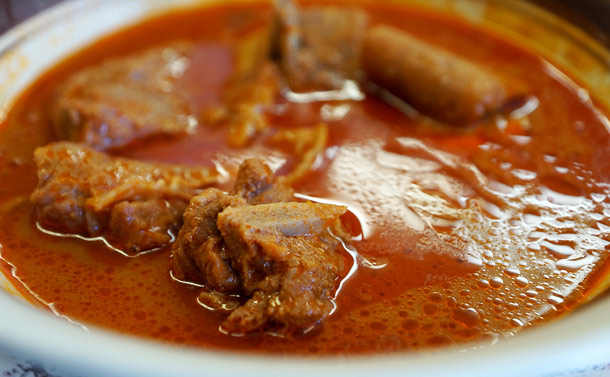
Just as the people of the western world enjoy mashed potatoes and Turkey as a symbol of Christmas celebrations, the symbol of West Africa Ghanaians is the famous Fufu and chicken soup.
Gone are the days where rice and chicken stew was the norm for every Christmas, now the intake of rice has become a ‘normal ‘ habit, in the lives of an average Ghanaian so much so that, now the intake of fufu, during this festive season is much appreciated.
Fufu (or foofoo, fufuo, foufou) is a staple food common in many countries in West Africa and Central Africa such as Ghana, Sierra Leone, Guinea, Liberia, Cote D’Ivoire, Benin, Togo, Nigeria, both Congos, Cameroon, the Central African Republic and Gabon, and is also found in the Caribbean.
It is often made in the traditional Ghanaian, Nigerian and Cuba method by mixing and pounding separate equal portions of cassava and green plantain flour thoroughly with water. It is then adjusted to either increase or decrease the stickyness of the fufu depending on personal preferences.
Other flours, such as semolina, maize flour or mashed plantains may take the place of cassava flour. Fufu is often served with groundnut soup, palm nut soup, abunuabunu or light soup.
The traditional method is to boil starchy food crops like cassava, yams or plantains and cocoyams and then pound them into a dough-like consistency. Fufu is eaten with the fingers, and a small ball of it can be dipped into an accompanying soup or sauce.
With its history dating back to the early days of colonial rule by the Portuguese, the Portuguese traders introduced cassava to Africa from Brazil in the 16th century.
In Ghana, fufu, also known as fufuo, is white and sticky (if plantain is not mixed with the cassava when pounding). The traditional method of eating fufu is to pinch some of the fufu off in one’s right hand fingers and form it into an easily ingested round ball. The ball is then dipped in the soup before being eaten.
In Côte d’Ivoire, the word “foutou” is also used. Ivorian “foufou” is specifically sweet mashed bananas, whereas the “foutou” is a stronger, heavier paste made of various staple foods such as yam, cassava, banana, taro or a mix of any of those.
In the French-speaking regions of Cameroon, it is called “couscous” (not to be confused with the North African dish couscous).
A similar staple in the African Great Lakes region is ugali. It is usually made from maize flour (masa), and is also eaten in Southern Africa. The name ugali is used to refer to the dish in Kenya and Tanzania, ubugali in Rwanda. Closely related staples are called nshima in Zambia, nsima in Malawi, sadza in Zimbabwe, pap or vuswa in South Africa, posho in Uganda, luku, fufu, nshima, moteke, semoule, ugali and bugari in the Republic of the Congo and in the Democratic Republic of the Congo and phaletšhe in Botswana.
In Caribbean nations with substantial populations of West African origin, such as Cuba, Jamaica, the Dominican Republic, Haiti and Puerto Rico, plantains, yuca or yams are mashed with other ingredients (fufú nigeriano). In Cuba, the dish retains its original African stem name, termed simply as fufú or with added descriptive extensions like fufú de platano or fufú de platano pintón. On other major islands, fufú goes by the names of mangú in the Dominican Republic, mofongo and funche in Puerto Rico and bammy in Jamaica.
What distinguishes the Caribbean “fufú” from its West African relative is a firmer texture with stronger flavors. As it moves away from Cuba, the fufú’s core is less a gelatinous dough and more of a consistent mass.
Puerto Rican mofongo, in keeping with the creolized cuisine traditions of the Caribbean, tends toward a fufú of much higher density and robust seasoning. While keeping a conspicuous African character, mofongo has borrowed from the island’s Iberian culinary tradition, to create a dish made of fried green plantains, yuca or breadfruit. Unlike the mushier Caribbean and West African fufú, mofongo is generally firmer and crustier.
To prepare mofongo, green plantains are deep-fried once unlike twice fried to stones. Next, they are mashed in a ‘pilon’ (mortar) with chopped garlic, salt, black pepper and olive oil. The resulting mash is then pressed and rounded into a hollowed crusty orb. Meat, traditionally chicharrón, is then stuffed into the chunky ball of fried green plantains.
A few recipes call for a meat or vegetable salsa criolla” (related to American Creole sauce) poured on top of the hot sphere. In the trendier “mofongo relleno,” typical of western Puerto Rico, seafood is all over, inside and outside. Traditional mofongo, as previously cited, comes seasoned and stuffed with meat and bathed in a chicken broth soup. Because of its elaborate process of preparation and its sundry ingredients, poet and blogger Arose N Daghetto called the mofongo a type of “fufú paella” and branded it as “the big daddy of fufús.”
A dish called funche made with taro, green and yellow plantains boiled and mashed with butter, garlic, and pork fat was once popular in Puerto Rico. Once mashed it was formed into balls and eaten with broth made from sesame seeds. Funche is written in early Puerto Rican cookbooks around the 1800s, but can probably be traced back to African slaves on the island. Funche today in Puerto Rico is cornmeal cooked in coconut milk and milk.
Fufu is believed to originate in what is modern-day Ghana, by the Asante, the Akuapem, the Guans, the Akyem, the Bono and the Fante peoples of the Akan ethnic group of Ghana. Today, it also features in Beninese cuisine, Togolese cuisine, Guinean cuisine, Cameroonian cuisine, as well as Nigerian cuisine.
PREPARATION
In Ghana, pieces of boiled cassava or other tubers are pounded together in a giant wooden mortar using a wooden pestle. In between blows from the pestle, the mixture is turned by hand and water gradually added till it becomes slurry and sticky. The mixture is then formed into a ball or a rounded slab and served. With the invention of the fufu machine preparation has become much less labour-intensive.
SOURCE: WIKIPEDIA
