



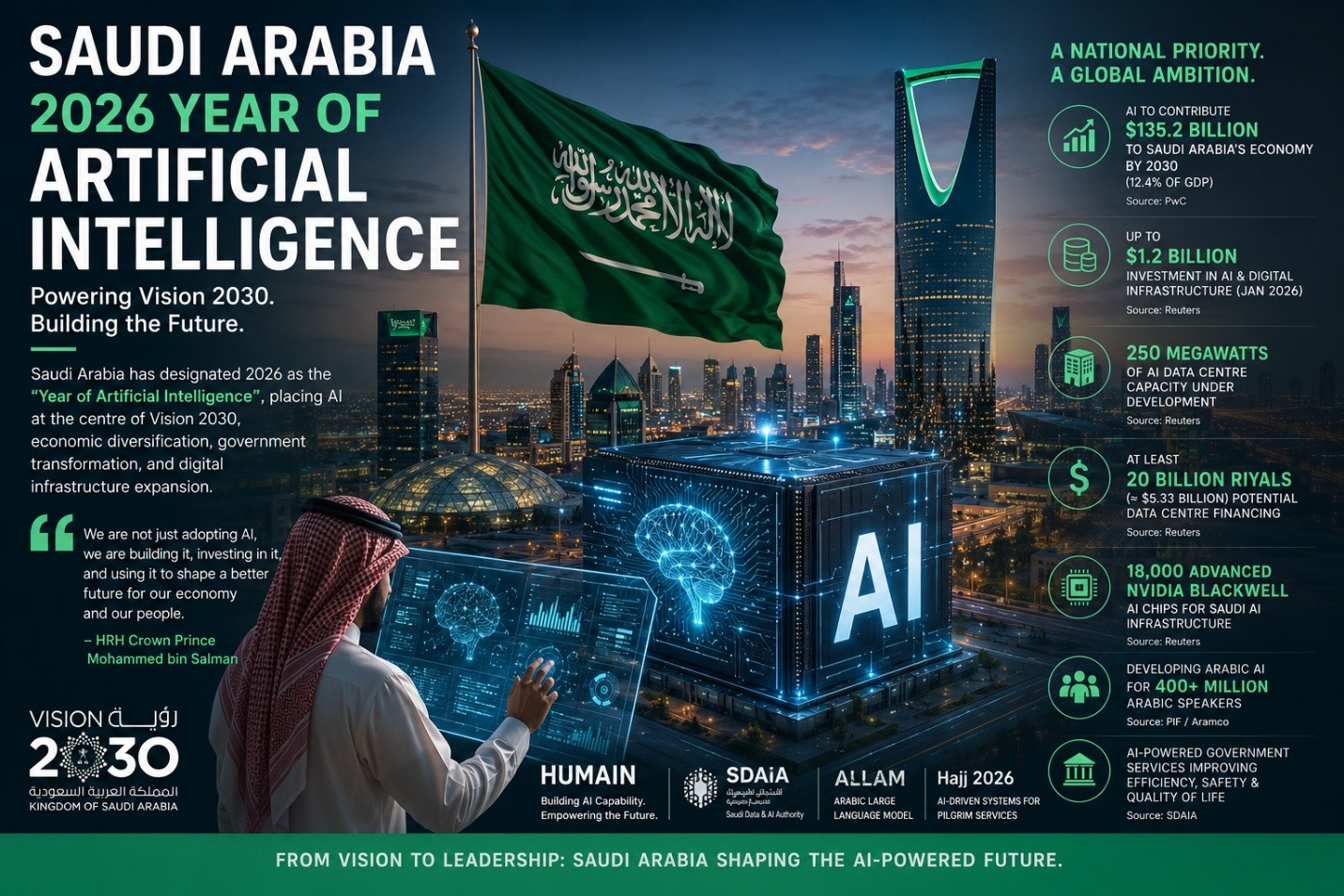
Saudi Arabia’s decision to designate 2026 as the “Year of Artificial Intelligence” is more than a symbolic declaration. It signals a decisive shift in the Kingdom’s economic transformation strategy, placing artificial intelligence at the center of Vision 2030, industrial diversification, public-sector reform, digital infrastructure, Arabic-language innovation and sovereign technology development.
The Saudi Data and Artificial Intelligence Authority confirmed that the Cabinet approved the designation of 2026 as the Year of Artificial Intelligence on March 10, 2026. The official framing is clear: AI is no longer treated as a narrow technology sector, but as a national development platform intended to support competitiveness, productivity, service delivery and future economic growth.
AI as a Core Pillar of Vision 2030
Saudi Arabia’s AI ambition is directly linked to Vision 2030, the national transformation program designed to diversify the economy away from oil dependency and expand non-oil sectors. Vision 2030’s broader objective is to build a more diversified, competitive and future-oriented economy, and AI is now being positioned as one of the major tools for achieving that transformation.
This direction reflects the Kingdom’s recognition that future economic power will increasingly depend on data, computing capacity, advanced algorithms, cloud infrastructure and digitally skilled human capital. According to PwC, AI could contribute more than US$135.2 billion to Saudi Arabia’s economy by 2030, equivalent to about 12.4% of GDP. This would make Saudi Arabia the largest beneficiary of AI in the Middle East in absolute economic terms.
HUMAIN: Saudi Arabia’s Flagship AI Company
The most important institutional development is the launch and expansion of HUMAIN, the Public Investment Fund-backed AI company chaired by Crown Prince Mohammed bin Salman. HUMAIN was launched to operate across the AI value chain, including next-generation data centers, AI infrastructure, cloud capabilities, advanced AI models and AI applications.
The company is central to Saudi Arabia’s sovereign AI strategy. Rather than only buying foreign AI tools, Saudi Arabia is attempting to build the infrastructure, models, computing power and applications required to become an AI producer. HUMAIN is expected to support AI adoption in sectors such as energy, healthcare, finance, manufacturing, education and government services.
The Public Investment Fund described HUMAIN as a platform that will provide “one of the world’s most powerful multimodal Arabic large language models,” showing the Kingdom’s focus on Arabic-language AI and digital sovereignty.
Building the Infrastructure of AI Power
AI leadership requires more than policy statements. It requires data centers, chips, cloud platforms, energy capacity and financing. This is where Saudi Arabia’s 2026 AI strategy becomes especially significant.
In January 2026, Reuters reported that HUMAIN secured up to US$1.2 billion from Saudi Arabia’s National Infrastructure Fund to expand AI and digital infrastructure. The agreement covers the development of up to 250 megawatts of AI data center capacity.
By May 2026, HUMAIN had reportedly selected Goldman Sachs to advise on a data-center financing package worth at least 20 billion riyals, approximately US$5.33 billion. Reuters reported that the financing would support data centers and GPU chips for 2 gigawatts of capacity, about one-third of HUMAIN’s reported target by 2034.
This matters because AI infrastructure is now becoming a strategic asset similar to ports, energy grids and telecommunications networks. Countries that control compute capacity can host models, train systems, serve enterprise clients and attract global technology partnerships.
Advanced Chips and Global Technology Partnerships
Saudi Arabia is also moving aggressively to secure access to advanced semiconductors. Nvidia is expected to supply 18,000 advanced Blackwell AI chips to HUMAIN as part of a broader partnership to support Saudi AI infrastructure.
Reuters also reported that AMD entered a US$10 billion collaboration with HUMAIN to establish AI computing infrastructure, while other major U.S. technology firms have been linked to broader Saudi AI and cloud investment commitments.
These partnerships show that Saudi Arabia is not only investing domestically; it is inserting itself into the global AI supply chain. The Kingdom is using sovereign capital, energy availability and strategic partnerships to become a serious AI infrastructure hub.
Arabic AI and the Question of Digital Sovereignty
One of the most important aspects of Saudi Arabia’s AI strategy is the development of Arabic-language AI. Most global large language models are trained primarily on English-language data, creating limitations for Arabic speakers, institutions and governments.
HUMAIN’s work on Arabic AI, including the ALLAM model, is therefore strategically important. It is not simply a language project. It is about cultural relevance, data sovereignty, national control over digital systems and the ability to build AI tools that understand Arabic language, context, religion, law, public administration and society.
This also gives Saudi Arabia a potential regional advantage. With more than 400 million Arabic speakers globally, Arabic AI could become one of the Kingdom’s most important technology exports.
AI in Government Transformation
Saudi Arabia is also applying AI in public administration. The Saudi Data and Artificial Intelligence Authority is the central national body responsible for data and AI, including big data, national platforms and AI-enabled public services.
A clear example came during the 2026 Hajj season, when SDAIA concluded its operational plan using AI-driven government support systems. These systems supported crowd management, pilgrim services, biometric tools, operational readiness and smart platforms designed to improve safety and efficiency during one of the world’s largest annual religious gatherings.
This shows how Saudi Arabia is using AI not only for economic competitiveness, but also for state capacity. In this context, AI becomes a public-sector management tool, improving logistics, service delivery, identity systems, crowd control and emergency response.
AI, Investment and the New Non-Oil Economy
Saudi Arabia’s AI push must be understood within its wider economic diversification agenda. The Kingdom is still one of the world’s largest oil exporters, but Vision 2030 is designed to reduce long-term dependence on hydrocarbons by expanding sectors such as technology, tourism, logistics, manufacturing, entertainment and financial services.
AI supports this agenda in two ways. First, it creates a new high-value sector through data centers, cloud services, AI companies and software development. Second, it improves productivity across existing sectors, including energy, healthcare, transport, education and government.
Saudi Arabia’s ranking also shows measurable progress. The Kingdom ranked 14th in the 2025 Global AI Index and has been identified as a leading Arab country in AI model development.
Human Capital and Workforce Development
Designating 2026 as the Year of AI also places emphasis on skills. Saudi Arabia’s AI strategy depends on training citizens, building technical capacity and preparing workers for a labour market increasingly shaped by automation, data analysis and intelligent systems.
SDAIA has been implementing national programs to build AI awareness and skills, while Saudi institutions are expanding initiatives around data science, AI literacy and digital talent development.
This is critical because infrastructure alone is not enough. Without engineers, data scientists, AI policy experts, cybersecurity professionals and sector specialists, AI investments risk becoming imported systems rather than national capability.
Strategic Meaning for the Gulf and the Global AI Race
Saudi Arabia’s AI strategy is part of a wider Gulf competition involving the UAE, Qatar and other regional players. However, Saudi Arabia has several advantages: a large domestic market, sovereign wealth, energy resources, land for data centers, political commitment and the scale of Vision 2030.
The Kingdom’s approach is increasingly clear. It wants to become not just a consumer of AI but a builder of AI infrastructure, an owner of AI platforms and a regional hub for AI applications. This places Saudi Arabia in direct competition with other AI infrastructure centers globally.
As Nvidia CEO Jensen Huang stated in relation to the Saudi partnership, “AI, like electricity and internet, is essential infrastructure for every nation.”
That statement captures the logic behind Saudi Arabia’s 2026 AI push. AI is no longer being treated as a future technology. It is being treated as national infrastructure.
Navigating the Road Ahead
Saudi Arabia’s ambitious AI strategy presents significant opportunities to strengthen its technological leadership. Continued investment in advanced chips, energy-efficient data centers, regulatory frameworks, cybersecurity, data governance and local talent development will further enhance the Kingdom’s AI ecosystem.
While AI infrastructure requires substantial capital investment, these foundations position Saudi Arabia for long-term economic returns. Success will increasingly be measured by the country’s ability to develop home-grown AI applications, intellectual property, enterprise solutions and globally competitive technologies, reinforcing its vision of becoming a leading international AI innovation hub.
Conclusion: From Oil Power to AI Power
Saudi Arabia’s declaration of 2026 as the Year of Artificial Intelligence marks a major stage in the Kingdom’s transformation under Vision 2030. Through HUMAIN, SDAIA, sovereign investment, advanced chips, Arabic-language AI, public-sector adoption and large-scale data-center financing, the Kingdom is positioning AI as a central engine of its next economic chapter.
The figures are significant: US$135.2 billion in projected AI contribution to GDP by 2030, up to US$1.2 billion in early 2026 infrastructure financing, 250 megawatts of planned data-center capacity under one agreement, at least 20 billion riyals in potential data-center financing, 18,000 advanced Nvidia chips, and a broader ambition to build gigawatt-scale AI infrastructure.
Saudi Arabia’s AI strategy is therefore not just about technology. It is about sovereignty, competitiveness, diversification and geopolitical positioning. In 2026, the Kingdom is making a clear statement: the next phase of Vision 2030 will be powered not only by oil, capital and infrastructure, but by data, algorithms and artificial intelligence.
Written By: Seade Caesar, Ch.E. MIoD
